
The Chief AI Officer Role Has Appeared in Hundreds of Local Governments in 18 Months -- and Most of Them Have No Idea What They Are Supposed to Be Buying

 City Governments
  0
0
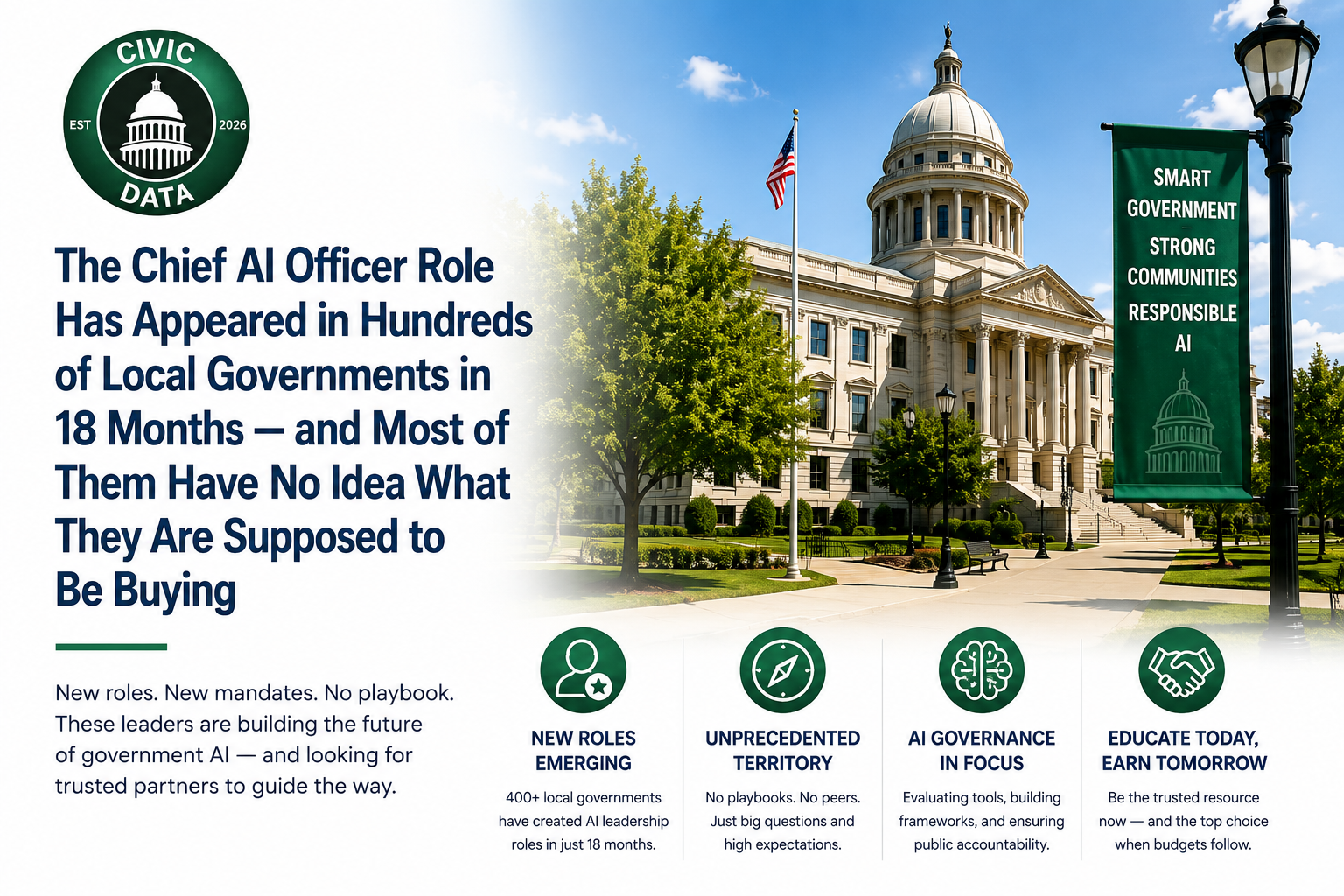
More than 400 local governments have created Chief AI Officer or AI Governance Director roles in the past 18 months. Most are in unprecedented territory with no established playbooks, no peer networks, and no vendor relationships yet
The Chief AI Officer Role Has Appeared in Hundreds of Local Governments in 18 Months -- and Most of Them Have No Idea What They Are Supposed to Be Buying
In the 18 months following the public release of large language model tools that made artificial intelligence tangibly visible to non-technical audiences, more than 400 state and local governments in the United States created some version of a Chief AI Officer, AI Governance Director, Technology Ethics Lead, or Responsible AI Coordinator role. This is a genuinely remarkable pace of institutional response to a technology development -- few technology trends have produced this volume of dedicated government leadership roles in this short a timeframe.
What is equally remarkable, and significantly less well-reported, is the degree to which these officials are in genuinely unprecedented territory. There is no established government AI governance playbook. There are no decades of case law and regulatory guidance to draw on. The professional network of peer officials in comparable roles is, at most, 18 months deep. And the vendor market serving government AI governance -- AI auditing tools, algorithmic bias detection platforms, public transparency infrastructure, AI use policy management systems -- is itself still in early formation, with a mix of genuine solutions and premature products that most of these officials are not yet equipped to evaluate.
The result is a purchasing environment defined by learning rather than by established evaluation criteria -- and for vendors who understand this, it is one of the most accessible and relationship-building-friendly purchasing conversations available anywhere in the public sector market right now.
Why This Role Emerged So Quickly
The speed with which the Chief AI Officer role proliferated across local government reflects a combination of genuine policy urgency and institutional risk management. Local governments are already using AI -- for 311 routing, for permit processing optimization, for predictive maintenance of infrastructure assets, for benefits eligibility screening -- and the public visibility of AI capabilities created by large language model tools has made the governance of these existing uses a political priority in ways it was not previously.
The risk management dimension is significant. A local government that makes a consequential error in an AI-assisted decision -- an algorithmic bias issue in benefits screening, a 311 routing error that delays an emergency response, a permit optimization that disadvantages specific neighborhoods -- is exposed to legal liability, civil rights complaints, and political accountability in ways that have become increasingly real as AI governance litigation and federal agency guidance have developed. Creating a dedicated AI governance role is, for many governments, as much a liability management response as it is a genuine commitment to responsible AI deployment.
This rapid role proliferation pattern is consistent with what the research across this content series has documented for other newly created government roles. The Infrastructure Law-created roles documented in Civic Data's research on Infrastructure Program Managers and Federal Grants Compliance Directors appeared at a similarly rapid pace and for similarly mixed reasons -- genuine operational need combined with compliance requirement and political visibility. And the short-term rental regulation officials documented in Civic Data's research on STR compliance officers as the fastest-growing new government contact category emerged from the same combination of public pressure, legal exposure, and peer jurisdiction behavior that is driving AI governance role creation. In all three cases, a new contact tier appeared faster than commercial contact databases could keep pace with.
What These Officials Are Actually Tasked With
The mandate of a local government Chief AI Officer or AI Governance Director varies significantly by jurisdiction, but the core responsibilities cluster around four areas that are genuinely new for most governments and that create distinct technology purchasing needs.
AI use policy development and implementation -- creating the governance frameworks that determine which AI applications are permitted, which require specific safeguards, and which are prohibited in government operations. This is primarily a policy and process work product, but it requires technology support for policy management, version control, and the audit trail documentation that allows a government to demonstrate compliance with its own AI policies.
Algorithmic accountability and bias auditing -- evaluating the AI systems already in use by the government for potential discriminatory impact, transparency failures, or outcomes that conflict with civil rights and equal treatment obligations. This requires both the analytical capability to conduct bias audits and the technology infrastructure to document, track, and report findings in ways that satisfy both internal governance and external accountability demands.
Vendor AI evaluation -- assessing the AI capabilities embedded in the technology products the government is already purchasing or considering purchasing, and ensuring that those AI components meet the governance standards the AI policy requires. This is a newly important dimension of government procurement that most procurement offices are not yet equipped to handle without dedicated AI governance support.
Public transparency and accountability -- communicating with residents about how government AI is being used, providing accessible explanations of AI-assisted decisions that affect individuals, and maintaining the public trust infrastructure that makes AI deployment politically sustainable over time.
The GovTech champion officials documented in Civic Data's research on the new generation of forward-leaning local government technology buyers are frequently the same officials now managing AI governance mandates -- the Chief Innovation Officers and Directors of Digital Services who championed participatory budgeting and digital permitting tools are the ones being asked to build AI governance frameworks alongside their existing innovation portfolios. This overlap creates a purchasing contact with unusually broad technology authority and unusually strong motivation to build vendor relationships with companies that understand both the operational technology and the governance dimensions of the government technology landscape.
Why Showing Up as an Educator Is the Winning Strategy
The AI governance officials who are most genuinely in unprecedented territory -- the ones who are building frameworks from scratch without established playbooks, who are evaluating vendor products in a category they have not previously worked in, and who are trying to balance the genuine potential of government AI with the genuine accountability risks -- are not primarily looking for products. They are looking for understanding. The vendor who can help them understand what questions to ask, what failure modes to watch for, what their peer officials at comparable jurisdictions have learned, and what the genuine landscape of available solutions looks like is providing something more valuable than any specific product claim.
This is a teaching conversation, not a sales conversation -- at least initially. The AI governance official who learns from a vendor interaction how to evaluate AI bias auditing tools is, months later, in a position to evaluate the vendor's own AI bias auditing tool with far more genuine confidence than they would have had without the educational foundation. The vendor who provided that education has earned a position in the evaluation that a vendor who only showed up with a product pitch has not.
The post-FAFSA enrollment official dynamic documented in College Data's research on enrollment officials who now trust their own data over any vendor claim has a specific parallel here. Just as post-FAFSA enrollment officials reward vendors who engage with them at a level of methodological transparency they now bring to every evaluation, AI governance officials reward vendors who engage at the level of genuine intellectual honesty about what AI governance tools can and cannot do. Both buyer types have been given, by their professional experience, a high sensitivity to overconfident external claims -- and both respond better to educational engagement than to outcome promises that exceed what the underlying technology can credibly deliver.
The Technology Categories These Officials Are Beginning to Evaluate
As AI governance roles mature past the initial policy development phase into implementation, specific technology categories are emerging as active purchasing priorities.
AI audit platforms -- tools that evaluate AI systems for bias, transparency, accuracy, and compliance with specific governance standards -- are the most immediately relevant purchasing category. These are specialized products that most government IT departments have never evaluated before, which means the AI governance official is frequently the first person in their organization to conduct this kind of evaluation and has limited internal expertise to draw on.
AI use registries and inventory management systems -- platforms that maintain a current, auditable record of all AI systems in use by the government, their specific applications, their governance status, and their compliance with AI use policies -- are a foundational governance infrastructure need that most governments are managing manually or not at all. The transition from manual AI inventory management to systematic platform-based tracking is an early purchasing priority for governments that have developed AI use policies sophisticated enough to require active compliance monitoring.
Public-facing AI transparency tools -- interfaces that allow residents to understand how AI is being used in government decisions that affect them, to request explanations of AI-assisted outcomes, and to provide feedback on AI deployment -- are a civic engagement and accountability technology category that connects the AI governance mandate to the participatory government technology documented in other research in this content series.
- Add Chief AI Officer, AI Governance Director, and Technology Ethics Lead as distinct, searchable contact categories in your government mailing list -- specifically built from government press releases, technology conference speaker lists, and AI governance professional network membership rather than from standard government employee directories.
- Build your initial outreach as educational content rather than product pitches -- thought leadership about AI governance frameworks, case studies of peer jurisdictions, and methodology guides for AI bias evaluation that provide genuine value before any product conversation begins.
- Track AI governance mandate adoption by state and jurisdiction -- governments in states that have passed AI governance legislation or that have experienced AI-related litigation are in the most urgent implementation mode and are therefore the most receptive to vendor relationships that help them meet compliance timelines.
- Map the overlap between AI governance officials and existing GovTech innovation contacts -- Chief Innovation Officers and Directors of Digital Services who have expanded their mandate to include AI governance are the most accessible entry point into this new contact tier.
The email timing research documented in Civic Data's research on government email marketing timing and the calendar-predictable engagement peaks that most vendors miss applies with particular force for AI governance officials. These officials are operating under compliance timelines set by AI governance mandates, legislative deadlines, and peer jurisdiction accountability pressure that create specific urgency windows -- the vendor who tracks these timelines and arrives with relevant educational content during them is reaching a buyer at peak receptivity. The state agency connection documented in Civic Data's research on state agencies as the most underused government contact list in education funding extends to AI governance: state chief technology officers and state AI councils are setting policy frameworks that create implementation urgency at every local government in their state simultaneously.
Conclusion
More than 400 local governments have created Chief AI Officer and AI Governance Director roles in the past 18 months. Most of these officials are in genuinely unprecedented territory, building governance frameworks without established playbooks, evaluating vendor products in a category they have not previously worked in, and managing public accountability for a technology deployment that is politically visible in ways that most government technology has not been. The vendors who understand this and who show up as educators rather than salespeople are building the relationships that will convert into purchasing decisions as these officials develop their governance frameworks and as their budgets catch up to their mandates. The vendors who are waiting for these officials to issue RFPs for products they understand are going to be waiting a long time -- and arriving after the relationships that determine RFP outcomes have already been formed.
K12 Data -- Build a List | Pricing | Blog College Data -- Build a List | Pricing | Blog Physician Data -- Build a List | Blog Civic Data -- Build a List | Blog K12 Talent -- Post a Job | Search Jobs | Blog