
Government Email Marketing Has a Timing Problem That Almost Nobody Has Solved, and the Solution Is Simpler Than It Looks

 City Governments
  0
0
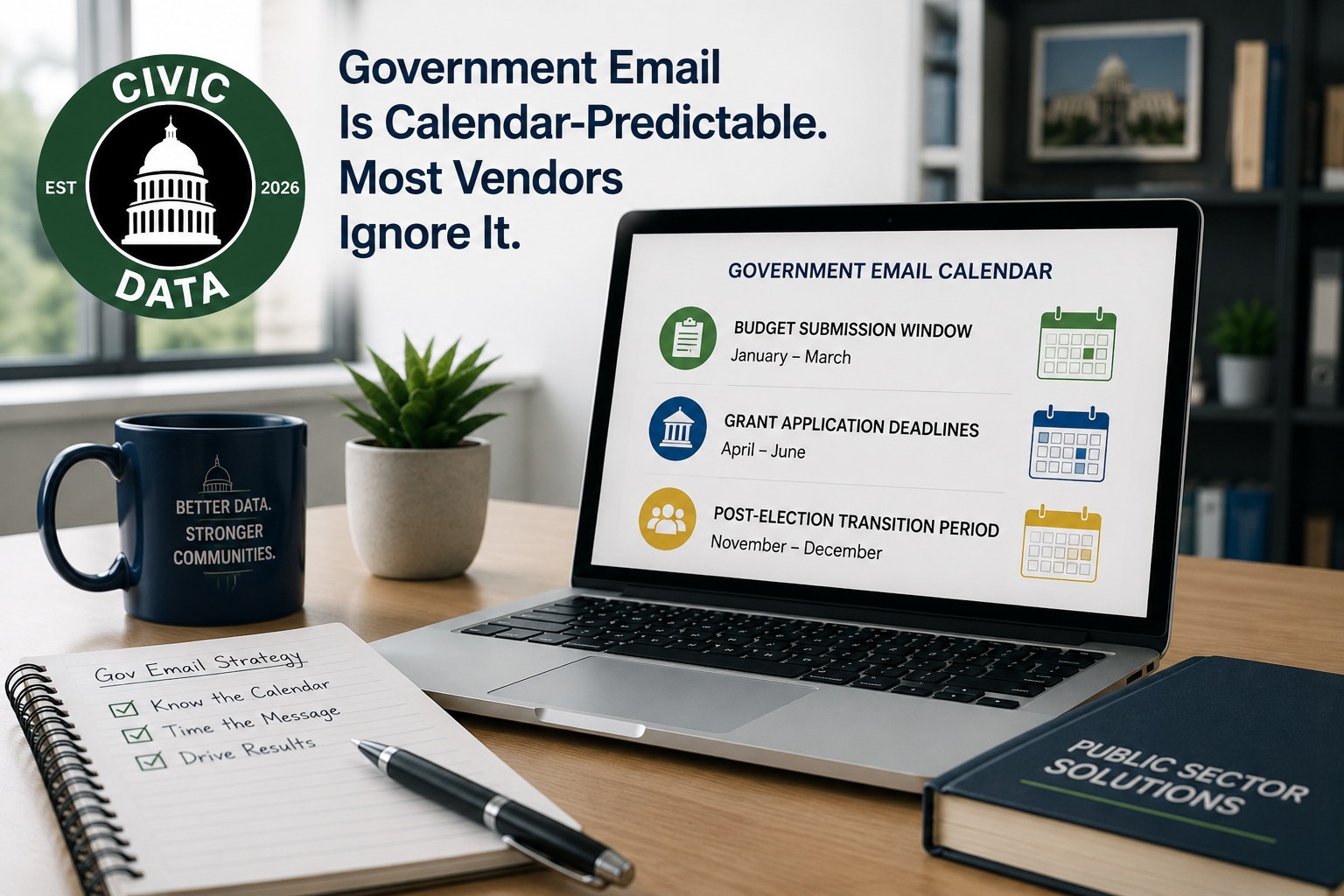
Government officials have the most predictable email engagement patterns of any B2B audience -- and most vendors completely ignore those patterns. Budget cycles, grant windows, and election transitions create calendar-predictable peaks that most campaigns never account for.
Government Email Marketing Has a Timing Problem That Almost Nobody Has Solved -- and the Solution Is Simpler Than It Looks
Government officials are, in one specific and important way, the most predictable B2B audience in existence. Their calendars are public. Their budget cycles are published. Their meeting schedules are posted months in advance. Grant application deadlines are announced at the beginning of each program cycle. Election cycles are known years in advance. The windows when government officials are in active decision-making mode, when they are in implementation mode, when they are in transition mode, and when they are genuinely not available because they are managing something all-consuming -- all of this is knowable before a single email is sent.
And yet most GovTech vendor email campaigns are built around the same generic Tuesday-morning-in-July schedule that drives B2B email marketing across every other vertical, with no adjustment for the specific calendar dynamics of the government audience. The result is a market where vendors who have mapped their email campaign calendar to the actual decision-making rhythms of local government officials are consistently generating pipeline from the same audience that their competitors, sending on the same generic schedule, are reporting as low-engagement and hard to reach.
The Government Calendar That Determines Email Engagement
Budget Season: The Highest-Value Window
Local government budget adoption cycles vary by jurisdiction, but most U.S. cities and counties operate on a fiscal year that requires budget submission and council approval in the spring -- with the most consequential budget decisions happening between January and May for jurisdictions with July 1 fiscal year starts, and between October and February for jurisdictions with January 1 fiscal year starts. The window immediately before budget adoption -- typically six to eight weeks before the final vote -- is the highest-value email engagement period for technology vendors whose products require budget line approval, because department heads and technology officials are actively building their funding requests and are genuinely receptive to information that helps them justify a technology investment to their governing body.
A vendor whose email arrives in the budget submission window with a clear ROI case, specific outcome data from comparable jurisdictions, and a format that a department head can excerpt for a budget justification document is providing genuine value at the precise moment when that value can be acted on. The same email arriving in August, after the budget has been adopted and the fiscal year has begun, is interesting but not actionable -- and interesting-but-not-actionable email is what produces the low response rates that GovTech vendors attribute to a generally unresponsive government audience.
Grant Application Windows: The Urgency Peak
Grant application deadlines create one of the most focused and most predictable email engagement peaks in government marketing. An official who is preparing a grant application for a program that would fund the technology category a vendor is selling is, in the weeks immediately before that deadline, genuinely and urgently looking for the information that will strengthen their application -- vendor quotes, outcome data, implementation timelines, and the specific technical specifications that granting agencies often require applicants to document. A vendor who identifies the grant programs relevant to their product category, tracks the application deadline calendars for those programs, and builds outreach sequences that arrive three to six weeks before major grant deadlines is providing exactly the right information at exactly the right moment.
This grant timing intelligence connects directly to the federal programs calendar documented in K12 Data's research on Title I Coordinator email timing. The federal fiscal year offset, the specific grant application windows for major federal programs, and the compliance reporting deadlines that create urgency in the months following a grant award all apply with equal force to the government officials documented in civic mailing lists as to the Federal Programs Directors documented in school district email lists. The pattern is the same: federal money creates calendar-predictable purchasing windows that generic campaign schedules routinely miss.
Post-Election Transition: The Relationship Window
The 90-to-120-day post-election transition period documented in earlier research in this content series as the highest-receptivity relationship-building window for GovTech vendors is also a distinct email engagement opportunity -- specifically for emails that offer value to a new official who is learning their role rather than pitching a product to an official who has already made their vendor decisions. A new City Manager or Chief Innovation Officer receiving an email in their first month that offers a peer jurisdiction technology benchmark, a relevant policy brief, or an invitation to a peer learning conversation is having a different experience of vendor email than the standard marketing pitch -- and that experience is building a relationship that may take six or twelve months to produce a purchasing conversation but that is far more durable than the relationship produced by a well-timed campaign that arrived at the right moment without any prior relationship foundation.
The Dead Zones to Avoid
Understanding when government officials are not reading vendor email is as valuable as understanding when they are. The two weeks immediately following a major election, when transition logistics are consuming all available attention. The first week of a new fiscal year, when implementation of the adopted budget is the organizational priority. The week immediately following a major council or board meeting that produced a controversial decision. These are moments when even a well-timed, well-written email to a verified government contact is competing with a level of organizational noise that makes any email engagement unlikely. Building these dead zones into the campaign calendar -- as send-pause periods rather than as campaign opportunities -- is the same kind of timing discipline that produces strong ROI in the windows that actually convert.
The Civic Mailing List Quality That Makes Timing Strategy Executable
The timing intelligence described above only produces ROI when it is applied to a civic mailing list that is current enough to reach the officials who are actually in the roles being targeted at the moment the email arrives. A government contact database with meaningful staleness -- former officials who have retired, new officials whose contact information has not been captured, officials who have moved roles within a jurisdiction -- defeats the timing strategy before it has a chance to work. An email timed perfectly to a budget submission window that arrives at a former department head's deactivated address is not generating pipeline. It is generating a hard bounce.
The list quality requirement for government email marketing is the same requirement documented for every other sector in this content series: the physician mailing list research shows the same hard bounce dynamics producing sender reputation damage at scale, and the college mailing list deliverability research documents the same authentication failure patterns at university email systems. In government, the additional complication is that government official turnover from elections, appointments, and retirements produces contact data staleness at a faster rate than most commercial sectors -- which means the continuous updating requirement for a government mailing list is higher than for most other B2B contact databases.
Email Strategy That Respects Government Culture
Beyond timing, government email marketing requires a content approach that respects the specific professional culture of government officials in a way that generic B2B marketing frequently does not. Government officials, particularly at the local level, are managing significant public accountability -- their purchasing decisions can be scrutinized through public records requests, their email correspondence is frequently subject to public records laws, and they are aware in a way that private-sector buyers are not that their professional communications are potentially public documents.
Email that acknowledges this reality -- that is transparent about who is sending it, what they are selling, and what outcome they are hoping for -- performs better with government audiences than email that obscures its commercial intent behind informational framing. Straight vendor email that is clearly identified as such, that provides specific and relevant value, and that makes a clear and respectful ask performs better in government than clever campaigns designed to appear to be something other than what they are. Government officials are sophisticated readers of intent, and the email that is honest about its purpose earns more trust than the one that is trying to be cleverly indirect.
- Build your government email campaign calendar around the budget submission window, major grant application deadlines, and the post-election transition period for your target jurisdictions -- these are the three highest-engagement windows and they are entirely calendar-predictable.
- Identify the grant programs relevant to your product category and track their application deadline calendars -- building outreach sequences to arrive three to six weeks before major deadlines positions you as a resource rather than an interruption.
- Schedule campaign pauses for the predictable dead zones: post-election transition logistics, first week of new fiscal year, and the week following major controversial council decisions.
- Invest in continuous government contact data maintenance at a higher frequency than you would for commercial B2B lists -- government official turnover from elections and appointments produces staleness faster than most other professional contact categories.
Conclusion
Government email marketing underperforms not because government officials are unresponsive but because most government email campaigns are applying generic B2B timing and content strategies to an audience with entirely predictable, entirely public, and almost entirely unaccounted-for calendar dynamics. The vendors who have mapped their email campaigns to the budget submission window, the grant application deadline calendar, and the post-election transition period are generating pipeline from the same officials that their competitors are reporting as hard to reach. The audience is not the problem. The campaign calendar is the problem -- and fixing it is genuinely simpler than the persistent underperformance of most GovTech email campaigns would suggest.
K12 Data -- Build a List | Pricing | Blog College Data -- Build a List | Pricing | Blog Physician Data -- Build a List | Blog Civic Data -- Build a List | Blog K12 Talent -- Post a Job | Search Jobs | Blog