
New York Just Banned Large Data Centers, and It Won't Be the Last State to Try

 City Governments
  0
0
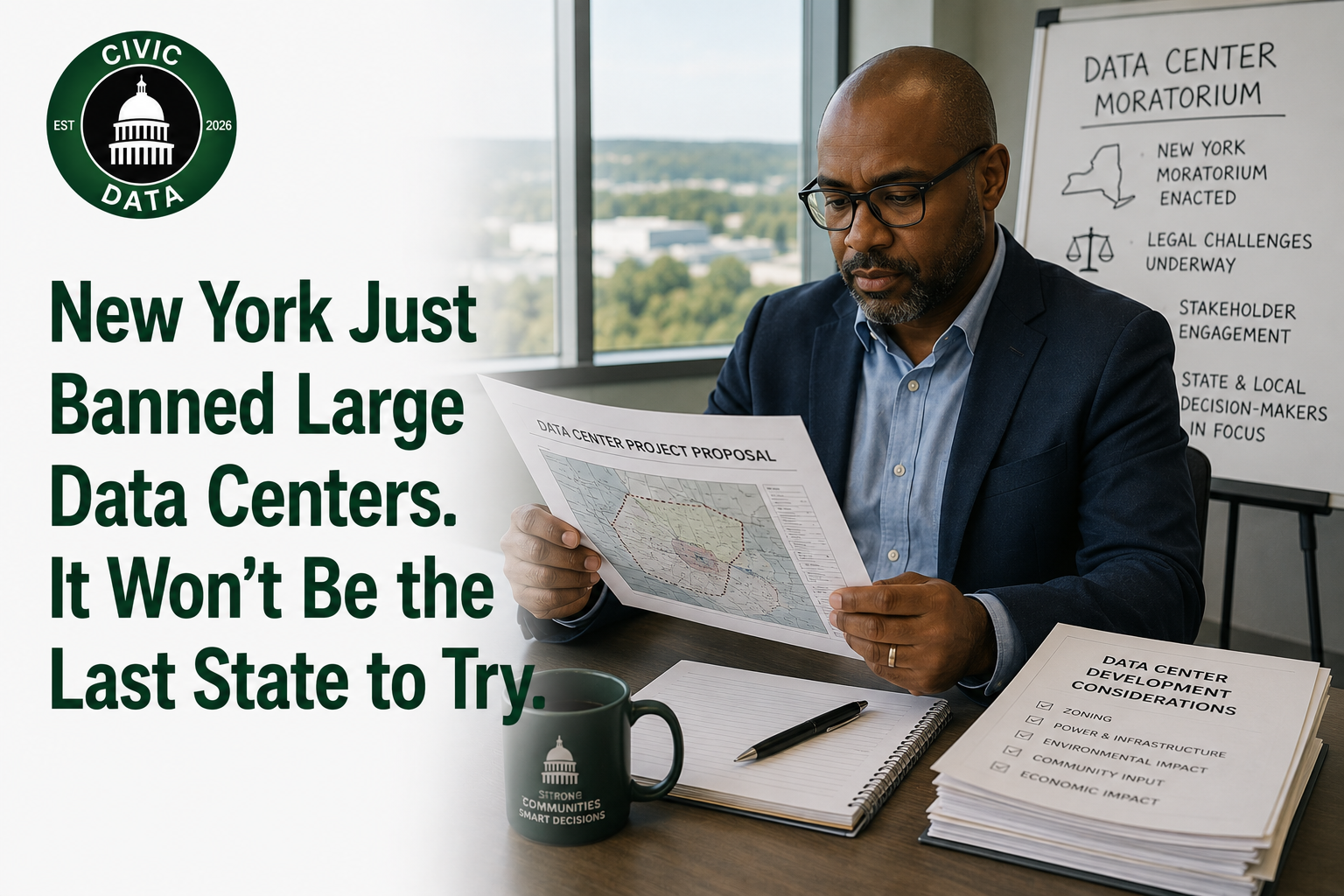
New York just signed the nation's first large data center moratorium, and local fights are erupting nationwide. A new category of government decision-maker just got created.
New York Just Banned Large Data Centers, and It Won't Be the Last State to Try
The data center gold rush just hit its first real wall. New York's governor signed the nation's first statewide moratorium on large data center construction this month, and a developer is already suing a rural New Jersey town after local officials reversed course and banned AI data centers following weeks of pressure from residents. What looked eighteen months ago like an unambiguous economic development win, chase the data center, land the jobs and the tax base, is now a live political fight in city councils and state legislatures across the country, and it is creating a category of government decision-maker that barely existed a year ago.
Vendors selling into state and local government need to understand this shift is not a niche zoning story. It is quickly becoming one of the defining local and state policy fights of the year, and the officials now responsible for navigating it are not necessarily who you would expect.
Why This Fight Escalated So Fast
Data centers require enormous amounts of electricity and water, and as AI-driven demand pushed a wave of new construction proposals into communities that had never dealt with an industrial user of this scale, residents began noticing the strain on local utility rates, water availability, and grid capacity well before most local governments had built any regulatory framework to evaluate these projects properly. The New Jersey lawsuit is a direct product of that mismatch: officials in a small town initially welcomed a proposal, then reversed course after residents organized against it, and now face litigation from a developer who reasonably expected the deal that was originally on the table.
New York's statewide moratorium takes this local pattern and elevates it to a policy level, effectively pausing new large-scale data center approvals while the state figures out how to balance economic development interest against grid capacity, water usage, and rate impacts on existing residential and commercial customers. Other states are watching closely, and several are expected to introduce similar legislation as their own legislatures reconvene.
The New Decision-Makers This Fight Creates
This is not simply a story about governors and state legislatures. Economic development directors, who spent the last several years actively courting data center investment as a reliable source of jobs and tax revenue, are now navigating a much more complicated calculus, having to weigh community pushback and potential moratorium risk against a deal that used to be an easy win to announce. Planning directors and zoning officials, who often had little established framework for evaluating a use this industrial and this water- and power-intensive, are being asked to build review processes essentially from scratch, sometimes under significant public pressure and tight timelines.
Utility regulators and public utility commission staff are facing an entirely new category of rate case and grid capacity question, since a single large data center can meaningfully affect regional electricity demand in a way that older industrial users rarely did. And city and county attorneys are increasingly involved earlier in the process than before, given the very real litigation risk demonstrated by the New Jersey case, where a reversed local decision led directly to a lawsuit.
Why the Purchasing Window Is Open Right Now
Local and state governments navigating this fight are actively evaluating a range of new needs: community engagement platforms to manage public input on a contentious process, utility rate modeling and grid impact assessment tools, updated zoning and land use frameworks specifically built to evaluate high-power, high-water industrial uses, and legal consulting to manage the litigation risk this new pattern has already demonstrated. None of this existed as a distinct, budgeted government purchasing category eighteen months ago.
This is precisely the kind of narrow, fast-moving policy fight that creates outsized purchasing urgency with comparatively little vendor competition, since most government-focused vendors are still targeting the same generic economic development and planning contacts they always have, without recognizing that the actual decision now involves utility regulators, community engagement specialists, and legal counsel working together in ways that did not require this level of coordination before.
Which Jurisdictions Are Moving Fastest
States and municipalities with existing or proposed large-scale data center projects already in the pipeline are moving fastest, since they are the ones facing immediate pressure to either approve, modify, or reject a specific pending proposal. States with significant existing tech industry presence and available land for large industrial development are also disproportionately exposed, since they represent the most attractive targets for future data center proposals and are therefore most likely to face this fight next, even if they have not yet.
Rural and semi-rural communities, like the New Jersey town at the center of the current lawsuit, deserve particular attention, since these are often the communities data center developers target specifically for available land and lower costs, and also the communities with the least existing regulatory infrastructure or in-house legal capacity to manage a contentious approval process and the litigation risk that can follow a reversed decision.
The Energy Grid Angle Deserves Its Own Attention
Beyond the political fight over siting, there is a real, technical grid capacity problem underneath all of this. A single hyperscale data center can draw as much power as a small city, and utility planners in regions with significant data center pipeline activity are having to rethink long-term generation and transmission planning in ways that used to unfold over a much longer time horizon. Some regions are seeing rate impact studies suggesting that data center demand is a meaningful contributor to rising electricity costs for residential customers, which is precisely the kind of pocketbook issue that turns a technical infrastructure question into a genuine political flashpoint at the local level.
This creates a real, near-term purchasing opportunity for grid modeling software, rate case consulting, and energy planning tools aimed specifically at utility commissions and municipal utility staff who are being asked, often for the first time, to model out what happens to regional capacity and residential rates if several large data centers move forward simultaneously. Vendors who can offer utility regulators clear, credible modeling tools are solving an urgent, technical problem that sits right at the center of this entire policy fight.
Community Engagement Technology Has a Real Moment Here
The New Jersey case is instructive precisely because it shows how quickly organized resident opposition can reverse a decision local officials had already made. Local governments facing a pending data center proposal are increasingly investing in community engagement platforms, public comment management tools, and transparent communication technology specifically to avoid getting caught flat-footed by exactly this kind of late-stage opposition. A government that can demonstrate a genuinely transparent, well-managed public input process is in a much stronger legal and political position than one that appears to have reversed course under pressure without a clear process to point to.
This is a specific, urgent technology need that most community engagement vendors have not yet framed explicitly around the data center fight, even though it is one of the clearest current use cases for exactly this kind of tool. Vendors who can speak directly to planning directors and economic development officials about managing a contentious data center approval process, rather than pitching community engagement software in the abstract, are likely to find a far more receptive audience right now.
Economic Development Offices Are Recalibrating Their Pitch
Economic development directors who built their reputation courting large industrial investment are having to recalibrate how they talk about these deals publicly, shifting from a straightforward jobs-and-tax-revenue pitch toward a more nuanced conversation that addresses grid capacity, water usage, and community impact upfront rather than waiting for residents to raise those concerns after a deal is already announced. This is a genuine communications and strategy shift, not just a policy one, and economic development offices are actively looking for guidance on how to manage this recalibration without losing legitimate investment interest entirely.
Some economic development offices are beginning to differentiate themselves by proactively building community benefit agreements and grid impact disclosures directly into their pitch to developers, positioning their jurisdiction as offering a more predictable, lower-litigation-risk approval path than a competing jurisdiction still operating without any framework at all. This is exactly the kind of forward-thinking approach that creates a genuine competitive advantage in attracting responsible investment while avoiding the New Jersey scenario.
What Jurisdictions Without a Pending Proposal Should Be Doing
Even jurisdictions without a current data center proposal on the table should be paying attention, since the pace of this industry's expansion means a proposal can arrive with relatively little warning, and the jurisdictions caught most flat-footed are consistently the ones that had no existing framework, no grid capacity study, and no community engagement process ready to deploy when a developer showed up. Building this infrastructure proactively, before a specific proposal forces the issue under time pressure, gives a jurisdiction real leverage to negotiate favorable terms rather than reacting defensively to community backlash after the fact.
This is a genuinely underexploited opportunity for vendors selling planning and zoning consulting, grid impact modeling, and community engagement platforms specifically to jurisdictions that have not yet faced this fight but are statistically likely to within the next year or two given ongoing industry expansion. Reaching these jurisdictions before a crisis forces a rushed decision positions a vendor as a trusted advisor rather than an emergency response purchase made under pressure.
Water Usage Is the Quieter Half of This Story
Electricity gets most of the attention in this fight, but water usage for cooling large data centers is becoming an equally significant concern in regions already managing drought risk or agricultural water competition. Jurisdictions in water-stressed regions are having to weigh data center water demand against existing agricultural and residential use in ways that add another layer of complexity to an already contentious approval process, and utility and water district officials are increasingly part of the same conversation that used to involve only economic development and planning staff.
This expands the actual buyer group for this entire category even further, pulling in water district managers and agricultural extension officials who would not have been part of a data center conversation a few years ago but are now essential voices in whether a proposal moves forward in water-constrained regions.
This is precisely why a static, once-a-year public sector email list purchase is the wrong model for this category. The jurisdictions responding to this fight need to be reachable continuously as the political landscape shifts, much like higher education institutions are discovering that a hard new federal borrowing cap requires constant, urgent communication with financial aid staff rather than a single annual outreach cycle. And K-12 hiring platforms are learning a similar lesson about speed, since reaching decision-makers during an active, unresolved policy window beats waiting for a settled outcome every time.
The Broader Pattern This Fits
This is a familiar shape for anyone tracking how fast-moving federal and state policy shifts create purchasing windows most vendors are too slow to notice. K-12 districts are living through a nearly identical dynamic right now, as a federal bill shifts significant compliance authority from Washington to the states essentially overnight, creating new decision-makers that most contact databases have not caught up to. Physician practices are facing their own version of a fast-moving, high-stakes decision window too, since a proposed federal reimbursement cut is compressing practice ownership decisions that used to unfold over years into a matter of months.
Vendors who build the habit of tracking these fast-moving local and state fights as they unfold, rather than waiting for a settled outcome, consistently find themselves first in front of decision-makers other vendors have not identified yet, and that head start compounds as more states introduce similar legislation.
New York's data center moratorium and the New Jersey lawsuit are not isolated local stories. They are the opening moves in what is shaping up to be one of the defining state and local policy fights of the year, and the economic development directors, planning officials, utility regulators, and government attorneys navigating it are actively looking for help right now. Vendors reaching these specific decision-makers, with government contact data that reflects the org chart this fight is actually creating, are stepping into a genuinely urgent conversation most competitors have not noticed yet.
Ready to reach the government officials navigating this fight? Build a government marketing database, or buy a government email list, with Civic Data today.
K12 Data — Build a List | Pricing | Blog College Data — Build a List | Pricing | Blog Physician Data — Build a List | Blog Civic Data — Build a List | Blog K12 Talent — Post a Job | Search Jobs | Blog