
Government Workforce Disruption Is Your Biggest Data Problem: Why Public Sector Email Lists Are Failing in 2025

 County Governments
  0
0
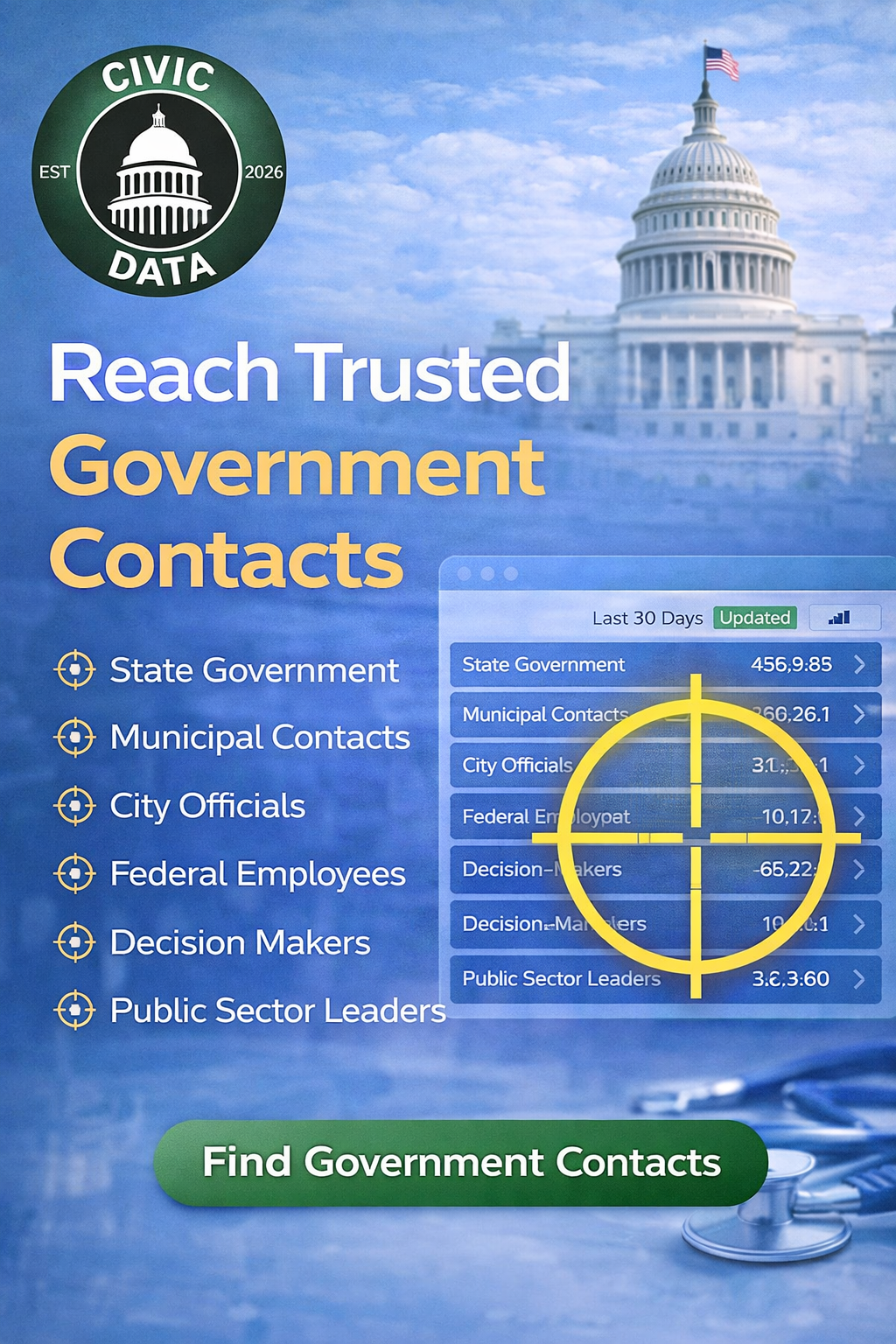
Election cycles, federal restructuring, and mass retirements are making government email lists obsolete faster than ever. Here is how live civic workforce data fixes it.
Government Workforce Disruption Is Your Biggest Data Problem: Why Public Sector Email Lists Are Failing in 2026
The public sector represents one of the most stable and significant buyer markets in the country. Federal, state, and local government agencies spend hundreds of billions of dollars annually on technology, professional services, infrastructure, staffing, and consulting. The SLED market — state, local, and education — is projected to exceed two hundred billion dollars in IT spend by 2030.
And yet the vendors and organizations trying to reach government buyers are largely doing so with government email lists and public sector contact data that is wrong — not because it was poorly built, but because the workforce it was built to represent is being restructured at a pace and scale that no static contact list can track.
In 2026, government workforce disruption is operating at a level with no recent precedent. Federal agencies are being reorganized, merged, and reduced in scope. Over 40 percent of federal IT professionals are now eligible for retirement, creating succession gaps across critical functions. Election cycles at the federal, state, and local level are turning over appointed officials and reshuffling department leadership. New technology roles — Chief Digital Officers, AI policy directors, cybersecurity program managers — are being created faster than legacy government marketing lists and public administration contacts databases are updated to include them.
Every one of these forces accelerates the decay of government email lists, municipal email lists, and state government email databases. And the organizations that have figured this out are quietly pulling ahead of every competitor still optimizing their subject lines while sending to contacts who no longer hold the role.
The full scope of this problem is documented in Government Workforce Data: Public Sector Outreach, Sales and Hiring — the most comprehensive treatment of how civic workforce disruption translates to outreach data failure. For a look at how these dynamics play out specifically at the county and municipal level, see Government Email List and Workforce Data: Public Sector Marketing.
Market Overview: The Four Forces Destroying Government Email List Accuracy in 2026
Most vendors targeting government buyers think of contact data decay as a slow, manageable problem — something handled with periodic list refreshes. The reality in 2026 is more disruptive than that. Four simultaneous forces are accelerating the rate at which public sector email lists and government decision makers lists become inaccurate.
Federal workforce restructuring. The scale of federal agency reorganization underway in 2026 is generating contact data disruption at a historic level. Agencies are being merged, reduced in scope, and in some cases significantly restructured. Federal employee email lists built on prior organizational charts are pointing to roles, offices, and email addresses that no longer exist in the same form — meaning outreach built on them is reaching the wrong people, wrong divisions, or no one at all.
Election-driven leadership turnover. Federal, state, and local election cycles replace appointed officials, department heads, and policy leadership at every level of government. A state government email database built before a gubernatorial election may reflect an entirely different cabinet and agency leadership structure by the following year. Municipal email lists face the same disruption whenever mayoral or city council transitions trigger department director reshuffles.
Mass retirements across government. More than 40 percent of federal IT professionals are currently eligible for retirement — and the retirement wave extends well beyond technology roles into administration, procurement, and program management. Government marketing lists and public administration contacts built on the tenured workforce of five years ago are increasingly lists of people who have already left or are on their way out.
New digital roles emerging faster than databases track them. State and local governments are creating Chief Digital Officers, data governance directors, AI policy leads, and cybersecurity program managers at scale — roles that barely existed five years ago and are largely absent from legacy government decision makers lists built before these role categories became standard.
Use Cases: Who Depends on Accurate Government Email Lists — and What They Lose Without Them
The range of organizations that depend on accurate public sector contact data for outreach spans virtually every major vendor and partner category serving government buyers.
Government technology vendors. Software companies, cloud providers, and IT infrastructure vendors targeting SLED agencies need government email lists segmented by agency function, technology role, and procurement authority. A government marketing list sorted only by agency name and size will route technology outreach to contacts who do not hold IT decision authority — or to roles that have been restructured since the list was built.
Professional services and consulting firms. Management consultants, policy advisors, and program implementation firms need public administration contacts at the department director and deputy secretary level — roles that turn over with political appointments and budget cycles. A state government email database that does not reflect current appointee rosters delivers outreach to predecessors or vacant positions.
Healthcare and public health organizations. Public health departments, Medicaid agencies, and behavioral health authorities are significant government buyers at the state and county level. Organizations that maintain both physician email lists and government email lists understand that these markets overlap constantly. The post How Physician Data Is Transforming Healthcare Marketing, Recruitment and Professional Outreach covers how the healthcare-government data intersection drives better outreach in both directions.
Education vendors and K-12 organizations. State education agencies, departments of education, and legislative education committees are major government buyers for curriculum, assessment, and EdTech products. Organizations maintaining both school email lists and public sector email lists understand that K-12 procurement authority frequently sits at both the district and state agency level simultaneously. The post How K-12 Education Data Is Powering the Next Generation of Targeted Outreach documents how this dual-layer approach works in practice.
Workforce development and staffing organizations. Peertopia — a K-20 education jobs platform and government jobs board — serves the intersection of public sector employment and talent development. Post a job | Search jobs | Peertopia blog.
Buyer Types: Mapping the Government Decision-Making Stack
Government procurement decisions are made across a layered structure of elected officials, political appointees, career civil servants, and procurement specialists. Effective government email lists and government decision makers lists must reflect this structure — not just the agency name.
Elected officials and political appointees. Governors, mayors, department secretaries, and agency directors hold the highest layer of decision-making authority. These roles turn over on election and appointment cycles, making them the most volatile layer of any government decision makers list. Outreach at this level must speak to policy priorities and constituent outcomes — and the contact data must be refreshed after every major election cycle to remain accurate.
Career civil service leadership. Deputy directors, division chiefs, and program managers provide institutional continuity across political transitions. They are often the most valuable long-term contacts for vendors — they outlast appointed leadership and carry institutional knowledge through transitions. A state government email database that distinguishes between political appointees and career civil servants allows vendors to maintain outreach continuity through leadership changes that would otherwise disrupt their entire contact strategy.
Procurement and contracting officers. These are the operational buyers managing RFPs, evaluating bids, and administering contracts. Public administration contacts at the procurement level require outreach built around compliance, value, and process — not strategic vision. Government marketing lists that reach procurement officers without also reaching program leadership miss half the buying committee.
Technology and digital leadership. Chief Information Officers, Chief Digital Officers, and directors of IT and cybersecurity are among the most heavily targeted — and most actively evolving — roles in government B2B outreach. Federal employee email lists and state government email databases that have not been updated since 2022 are increasingly missing new technology roles that now carry significant budget authority.
Local government leadership. City managers, county administrators, and municipal department directors represent a massive and fragmented buyer market. Municipal email lists for this layer of government are especially prone to decay — local government has the highest rate of role turnover and the least publicly visible announcement infrastructure for tracking those changes. A city government contact list that is not actively maintained becomes inaccurate faster than almost any other category of government contact data.
The full decision-making map across federal, state, and local government is laid out in Government Decision-Maker Map: Who Buys What — the most practical guide available for vendors building government marketing lists around actual procurement authority rather than agency names.
Data Strategy: What Accurate Civic Workforce Data Requires in 2026
Political cycle alignment. State and federal election cycles are the single largest driver of contact data decay at the leadership level. A government decision makers list that is not refreshed in the ninety-day window following major elections — when appointment and transition announcements cluster — will miss the highest-value contact changes of the entire electoral cycle. Build data refresh triggers around election calendars, not arbitrary quarterly schedules.
Layered segmentation by role type. Political appointees, career civil servants, and procurement professionals are three fundamentally different audiences requiring different messaging, different timing, and different outreach strategies. A public sector email list that does not distinguish between these layers will consistently misalign campaigns with the actual decision-making structure at target agencies.
Federal, state, and local distinctions. Federal employee email lists, state government email databases, and municipal email lists each represent different buyer structures, procurement authorities, and compliance environments. Treating all government marketing lists as interchangeable is one of the most common and costly mistakes in public sector outreach.
Cross-sector integration for overlapping markets. State education agencies overlap with K-12 districts — integrating civic workforce data with education contact data from K12 Data is a natural strategic pairing. Public health departments overlap with healthcare systems — where healthcare professional data from Physician Data and government email lists work best in combination. University research partnerships overlap with both — where higher education marketing data from College Data connects directly to the public sector buying relationship. The post Role-Based Targeting: Government, Education and Healthcare Marketing is the definitive resource for building cross-sector outreach strategies across all three markets.
ROI: What Accurate Government Marketing Lists Deliver
Selling to government is inherently a long-cycle process. Procurement codes, RFP requirements, and approval structures at the federal, state, and local level create evaluation timelines that can run six to eighteen months from first contact to contract award. In that environment, reaching the wrong contact at the wrong stage does not just waste one touchpoint — it can delay an entire sales cycle by a quarter or more.
- Higher engagement rates from government marketing lists, because outreach reaches current role-holders rather than predecessors, vacant positions, or restructured offices
- Shorter relationship-building timelines, because vendors establish contact with new appointees early — before competitors identify the transition
- Better RFP positioning, because vendors who reached program leadership before a solicitation was written are better aligned with the requirements it contains
- Reduced waste on federal employee email lists and state government email databases, because restructured, retired, or transitioned roles are removed before campaigns launch
- Stronger cross-sector outcomes for organizations using civic workforce data alongside school email lists, healthcare email lists, and university contact databases
The strategic compounding advantage is the most significant ROI driver. Vendors who establish contact with incoming department heads, newly appointed agency directors, and freshly installed city managers in the first ninety days of a leadership transition consistently outperform those who wait for official procurement announcements. The relationship advantage that comes from early engagement in a government transition is durable — it shapes the vendor landscape for the entire term of that leadership.
Trends: Where Public Sector Outreach Data Is Headed
Federal restructuring is creating the largest government email list disruption in decades. The scale and pace of federal agency reorganization in 2026 is generating contact data disruption across federal employee email lists at a level that has no modern precedent. Vendors with static federal contact databases built on prior organizational charts are operating on data that may be structurally wrong — not just outdated — for agencies that have been significantly reorganized. This is the single most urgent data accuracy challenge in government outreach right now.
The SLED market is growing more competitive as it grows larger. As SLED IT spend approaches two hundred billion dollars, the competition among vendors for state and local government relationships is intensifying. The vendors winning in this environment are those with the most accurate city government contact lists, state government email databases, and municipal email lists — because reaching the right decision-maker before the RFP drops is the single biggest competitive advantage in SLED sales.
New government technology roles are being created faster than databases track them. Chief Digital Officers, data governance directors, AI policy leads, and cybersecurity program managers are now standard at the state and major municipal level — yet largely absent from government decision makers lists built before 2022. Public sector email lists that have not been updated to reflect these roles are missing an increasingly powerful layer of government decision-making.
Cross-sector integration is becoming the competitive baseline. Organizations that maintain government marketing lists alongside school email lists from K12 Data, college email lists from College Data, and physician email lists from Physician Data are building unified outreach capabilities that single-sector contact list approaches cannot match. The convergence is documented in The Rise of Workforce Data — required reading for any organization operating across education, healthcare, and government simultaneously.
Conclusion
The government buyer market is enormous, structurally stable in purchasing volume, and critically important to virtually every major vendor category in technology, professional services, healthcare, education, and infrastructure. It is also, in 2026, experiencing a level of workforce disruption that is making static public sector email lists and outdated government marketing lists more costly to depend on than at any point in recent memory.
Election cycles rotate leadership. Federal restructuring eliminates and merges agencies. Mass retirements hollow out experienced career civil service ranks. New technology roles emerge faster than legacy public administration contacts are updated. Every one of these forces erodes the accuracy of the government email lists that vendor outreach depends on — and the erosion is accelerating, not slowing.
The organizations that recognize this and invest in continuously refreshed, role-accurate, politically-cycle-aware civic workforce data are building a durable competitive advantage in the public sector market. They reach new appointees first. They maintain continuity through leadership transitions. They position before RFPs drop. And they win contracts that static-list competitors do not even know are available.
Explore what accurate data can do for your outreach at Civic Data — Build a List | Pricing | Blog. For K-12 education contact data, visit K12 Data — Build a List | Blog. For higher education data, visit College Data — Build a List | Blog. For healthcare outreach, visit Physician Data — Build a List | Blog. For government and public sector targeting, visit Civic Data — Build a List | Blog. For K-20 and government hiring, visit Peertopia — Search Jobs | Post a Job | Blog.