
The AI Procurement Mandate Is the Fastest-Moving New Purchasing Category in Government — and Most Civic Mailing Lists Cannot Find the Decision-Makers Who Are Spending the Budget

 Federal Agencies
  0
0
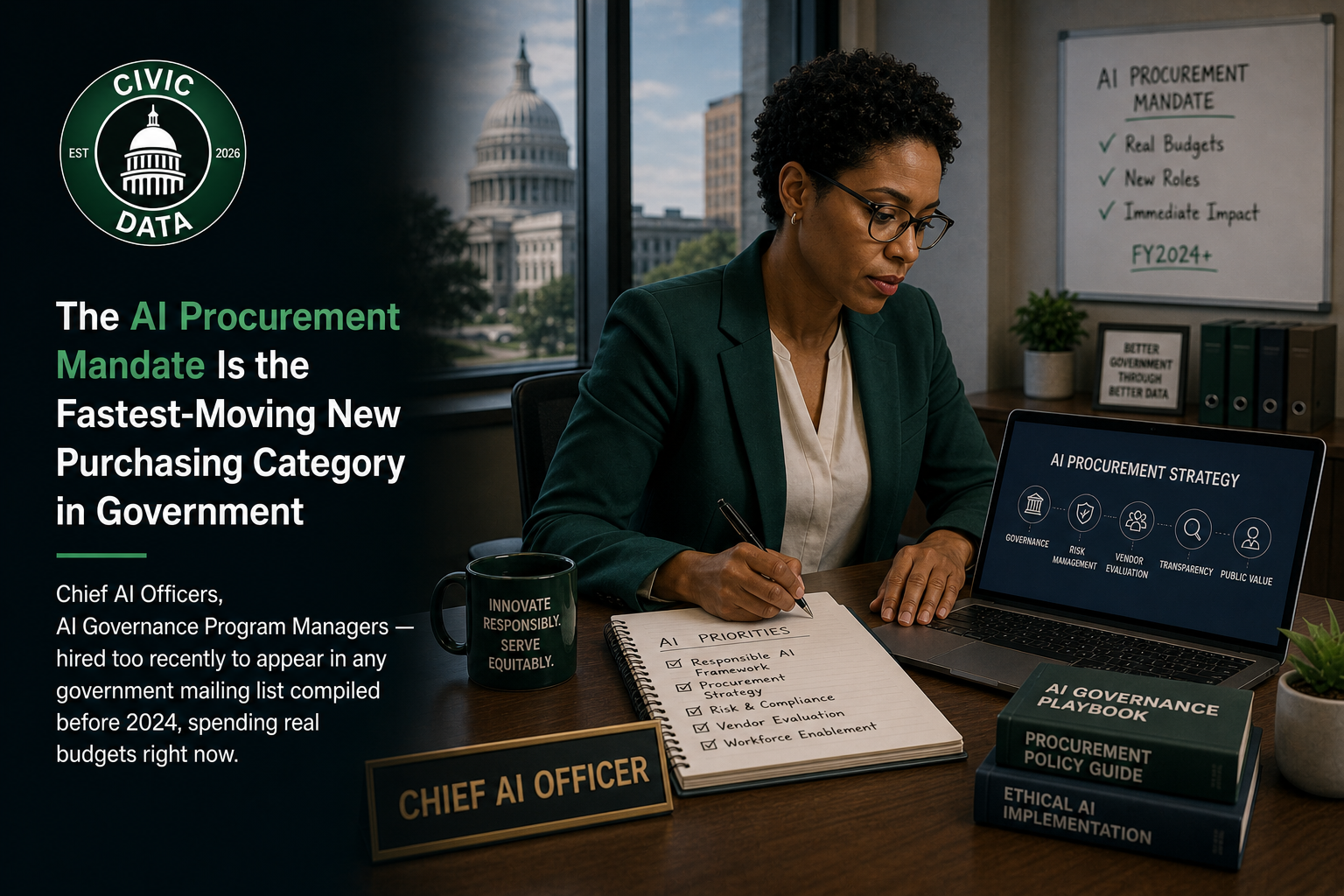
Government AI governance mandates have created Chief AI Officers with real purchasing authority — absent from most civic mailing lists compiled before 2024.
The AI Procurement Mandate Is the Fastest-Moving New Purchasing Category in Government — and Most Civic Mailing Lists Cannot Find the Decision-Makers Who Are Spending the Budget
Eighteen months ago, the Chief AI Officer was a title that existed at a handful of federal agencies under pilot programs, a scattering of progressive state governments experimenting with technology governance frameworks, and virtually nowhere at the county and municipal level. Today it is a formally required position at every major federal agency, a rapidly proliferating role at state governments across the political spectrum, and an emerging function at county and municipal governments of all sizes — carrying real purchasing authority over a vendor category that did not exist in most government procurement portfolios in 2023.
The government AI procurement mandate is not a single policy event. It is a layered regulatory environment constructed over the last two years through executive orders, state legislation, agency guidance documents, and federal procurement requirements that have created affirmative obligations for government agencies to evaluate, document, govern, and audit their AI deployments. The purchasing these obligations generate — for AI governance platforms, algorithmic accountability tools, model auditing services, AI risk assessment frameworks, and the data infrastructure to monitor AI system performance — is the fastest-growing and least-mapped new procurement category in government technology.
The contact data challenge is acute. The administrators holding purchasing authority for AI governance technology are, by definition, new to their roles. Chief AI Officers at federal agencies were appointed under executive mandates less than two years old. State Chief AI Officers were hired in a rolling wave of appointments throughout 2024 and 2025. AI Governance Program Managers at county and municipal governments are being created and filled on timelines driven by state legislative requirements varying in their implementation schedules. The result is a purchasing tier that is large, active, and almost entirely invisible to government mailing lists and civic email lists compiled before 2024 — because the people holding that purchasing authority were not in those roles when the lists were built.
Market Overview: How the AI Governance Mandate Has Structured Government Purchasing
The federal layer is the most formalized. Executive Order 14110 on the Safe, Secure, and Trustworthy Development and Use of Artificial Intelligence required federal agencies to appoint Chief AI Officers, establish AI governance frameworks, and implement risk management processes for AI systems used in agency operations. OMB's subsequent guidance — including M-24-10 — created structured procurement mandates for AI governance tools and documentation infrastructure that agencies need to comply with federal AI policy requirements.
At the state level, the legislative wave has been bipartisan and broad. More than 40 states have either enacted AI-related legislation or introduced significant AI governance bills in 2024 and 2025. Some states focus on algorithmic accountability requirements for automated decision systems in public benefits, law enforcement, or child welfare contexts. Others establish general AI governance frameworks for all state agency deployments. An increasing number require specific AI auditing and impact assessment processes before deploying AI in high-stakes government decisions. Each legislative framework generates implementation requirements — and implementation requirements generate procurement activity.
At the county and municipal level, AI governance mandates are emerging from state legislative requirements, federal grant conditions, and proactive governance frameworks adopted by counties and cities whose legal and risk management teams have concluded that unmanaged AI deployment creates liability exposure. The purchasing this generates at the local government level connects directly to the fiscal stress documented in Civic Data's research on the municipal pension and infrastructure convergence crisis — municipalities already under financial pressure are prioritizing AI governance investments that reduce liability exposure rather than create new operational costs, making the ROI framing of AI governance technology a critical vendor positioning element in this market.
The New Government AI Purchasing Authority Map
Federal Agency Chief AI Officers
The Chief AI Officer at a federal agency has direct authority over the agency's AI governance framework, AI investment strategy, and AI vendor procurement decisions. Following M-24-10, federal agency CAIOs have specific regulatory obligations generating procurement requirements: AI use case inventory management systems, risk assessment documentation platforms, governance reporting infrastructure, and training and compliance management tools. These purchasing decisions bypass the traditional IT acquisition process at many agencies — made at the CAIO level with coordination from legal, risk, and acquisition leadership. Government mailing lists that include federal program directors but not CAIO-level contacts are missing the primary purchasing authority for the fastest-moving procurement category in federal government technology.
State Chief AI Officers and Technology Modernization Directors
State-level AI governance leadership has been created through gubernatorial appointments, legislative mandates, and state CIO office reorganizations. The State Chief AI Officer — a title now used in more than a dozen states — typically sits within the state CIO or CISO organizational structure and carries procurement authority for AI governance tools deployed across state agency AI systems. The Technology Modernization Director at states without a standalone CAIO role is frequently the functional equivalent — an administrator whose modernization mandate has been expanded to include AI governance as deployment has accelerated. State government email databases that do not include these roles as distinct primary contact categories are missing purchasing authority for AI governance technology across entire state government ecosystems.
AI Governance Program Managers at County and Municipal Levels
The AI Governance Program Manager is an emerging role at county and municipal governments of moderate to large size — typically created in response to state legislative requirements, federal grant conditions, or proactive risk management decisions. This role did not appear in most civic mailing lists and government contact databases compiled before 2024, because the role did not exist at most local governments before state AI legislation created the compliance obligation that required someone to manage it.
Government Legal Counsel and Risk Management Directors with AI Oversight Mandates
Government attorneys and risk management directors at agencies deploying AI are co-evaluators for AI liability management platforms, algorithmic impact assessment tools, and legal compliance infrastructure required to document AI deployment decisions in ways that withstand public records requests, legislative oversight, and judicial review. The Government Legal Counsel and Risk Management Director assigned AI oversight responsibility is a technology purchasing contact that government mailing lists built around program and IT contacts have not historically included as a buying decision-maker.
Use Cases: Which GovTech Vendors Are Most Active in the AI Governance Market
AI governance platform vendors. Platforms that help government agencies inventory their AI deployments, assess risk levels, document governance frameworks, and generate compliance reports are in active procurement at federal agencies, state governments, and an increasing number of county and municipal governments. The primary purchasing contacts — Chief AI Officers and Technology Modernization Directors — are new contact tiers that most civic mailing lists do not include.
Algorithmic auditing and impact assessment services firms. The requirement for algorithmic impact assessments evaluating the potential discriminatory or unintended consequence implications of AI systems used in government decision-making is generating procurement for both technology platforms and professional services. The compliance management parallel with College Data's research on ISSO Director technology purchasing is instructive: in both higher education and government, regulatory compliance mandates are creating new technology purchasing roles — ISSO Directors in higher education and AI Governance Program Managers in government — that standard contact databases built around program and operational contacts have not captured as high-priority buying tiers.
AI training and workforce development vendors. Government agencies implementing AI governance frameworks need to train employees who use AI systems, supervisors who oversee AI-assisted decisions, and leadership responsible for AI governance accountability. The purchasing contacts for government training programs span HR directors, AI governance program managers, and agency leadership — a cross-functional buying committee requiring government mailing lists that reach multiple contact tiers simultaneously. This cross-functional committee configuration is structurally similar to the CFO-plus-program-director buying committee documented in K12 Data's research on the mental health funding whipsaw creating new co-buyer configurations at K-12 districts — in both cases, the crisis-driven urgency has pulled financial and legal leadership into purchasing processes that program staff previously managed alone.
Data infrastructure and AI monitoring technology vendors. Government AI governance requires ongoing monitoring of AI system performance — tracking model accuracy, detecting distributional shift, documenting decision patterns for audit purposes. The purchasing contacts for AI monitoring and data infrastructure technology in government agencies are Chief AI Officers, data management directors, and technology modernization leadership. Physician Data's research on how PE physician group fracturing is creating new healthcare technology purchasing urgency on compressed timelines documents a parallel dynamic: in both healthcare and government, purchasing urgency driven by structural disruption — PE fracturing in healthcare, AI governance mandates in government — is generating procurement activity outside standard technology refresh cycles, reaching contacts that traditional databases have not mapped as primary buyers.
Data Strategy: Building Civic Mailing Lists That Capture the AI Governance Purchasing Wave
- Chief AI Officer as a primary federal and state contact tier. Government mailing lists targeting the AI governance market must include Chief AI Officers at federal agencies and state governments as distinct, high-priority contact categories — not subcategories within general IT leadership. These roles carry independent purchasing authority and their procurement decisions are made outside the standard IT acquisition process at many agencies.
- AI governance appointment announcements as real-time outreach triggers. Creation of new CAIO positions, Technology Modernization Director appointments, and AI Governance Program Manager hirings are publicly announced events — through agency press releases, state government news portals, and municipal meeting records. Government contact databases incorporating appointment announcement monitoring generate outreach trigger intelligence reaching new AI governance contacts within the first 30 days of their tenure.
- State AI legislation tracking as a predictive market signal. States with recently enacted AI governance legislation are in the implementation phase generating procurement activity within 12 to 24 months of legislative enactment. Government mailing lists segmented by state AI governance legislative status can identify which states and localities are about to generate AI governance procurement waves.
- Federal AI grant and pilot program participation as a purchasing urgency signal. Government agencies and local governments participating in federal AI-related grant programs — through NIST AI frameworks adoption grants, federal pilot program partnerships, and AI-related infrastructure funding — are in active AI governance implementation and active vendor evaluation simultaneously.
- Cooperative purchasing vehicle relationships as a market access strategy. The same fiscal pressure driving municipalities toward AI governance compliance is driving them toward cooperative purchasing vehicles that reduce procurement burden. GovTech vendors establishing NASPO ValuePoint, OMNIA Partners, or Sourcewell cooperative purchasing presence in the AI governance technology category build contract reach across hundreds of financially stressed municipalities through a single procurement channel.
Trends: Where Government AI Procurement Goes Through 2028
The AI governance mandate will expand from documentation to enforcement. The current wave of AI governance legislation creates documentation and assessment requirements. The next wave — already visible in aggressive state legislation and federal regulatory guidance being developed by the FTC, CFPB, and EEOC — will create enforcement mechanisms, audit rights, and liability frameworks that make AI governance compliance a legal risk management imperative rather than a best practice aspiration. Vendors positioned in the AI accountability and audit infrastructure space will find 2026-2028 to be the highest-growth window their market will see.
Municipal AI governance will become a standard local government function. The current distribution of AI governance purchasing is heavily weighted toward federal agencies and larger state governments. As state legislative requirements cascade to county and municipal compliance obligations and AI governance technology costs decrease with market maturation, AI governance will become standard at county and municipal governments of moderate size. The government mailing lists that include county and municipal AI Governance Program Manager contacts today are building contact data infrastructure for a market that will be mainstream in 24 months.
The cross-sector connection is significant and underutilized. AI governance technology vendors are serving federal agencies, state governments, health systems, higher education institutions, and K-12 districts simultaneously — because the AI governance mandate is operating across all institutional types at once. Organizations with government mailing lists alongside college mailing lists from College Data, physician mailing lists from Physician Data, and school mailing lists from K12 Data are positioned to reach the AI governance technology market across all institutional types from a single cross-sector contact intelligence infrastructure. The AI governance mandate is the first purchasing category in recent memory where the decision-makers in government, higher education, healthcare, and K-12 education are all buying the same product category at the same time — and the vendors who reach all four sectors simultaneously through integrated contact data across all four sites have a structural advantage that single-sector government mailing lists cannot replicate.
Conclusion
The AI procurement mandate has created the fastest-moving new purchasing category in government technology — and it has done so by generating an entirely new organizational tier of purchasing authority that most government mailing lists and civic email lists were not built to reach. Chief AI Officers were appointed after the last list refresh. AI Governance Program Managers were hired under state legislative requirements that did not exist when the contact database was compiled. Technology Modernization Directors have portfolios that expand beyond what their legacy titles suggest to standard segmentation logic.
The GovTech vendors whose civic mailing lists are updated to reflect this new purchasing tier — through CAIO contact inclusion, appointment announcement monitoring, state AI legislation tracking, and federal grant participation signals — are positioned to reach the fastest-growing purchasing category in government at the peak of its urgency. The vendors still routing AI governance outreach through standard IT director and program manager contacts are arriving at the wrong organizational level for decisions that have been elevated to governance leadership.
K12 Data — Build a List | Pricing | Blog College Data — Build a List | Pricing | Blog Physician Data — Build a List | Blog Civic Data — Build a List | Blog