
The $42 Billion BEAD Broadband Buildout Has Reached Construction, and It Just Created a New Category of Local Government Buyer

 Federal Agencies
  0
0
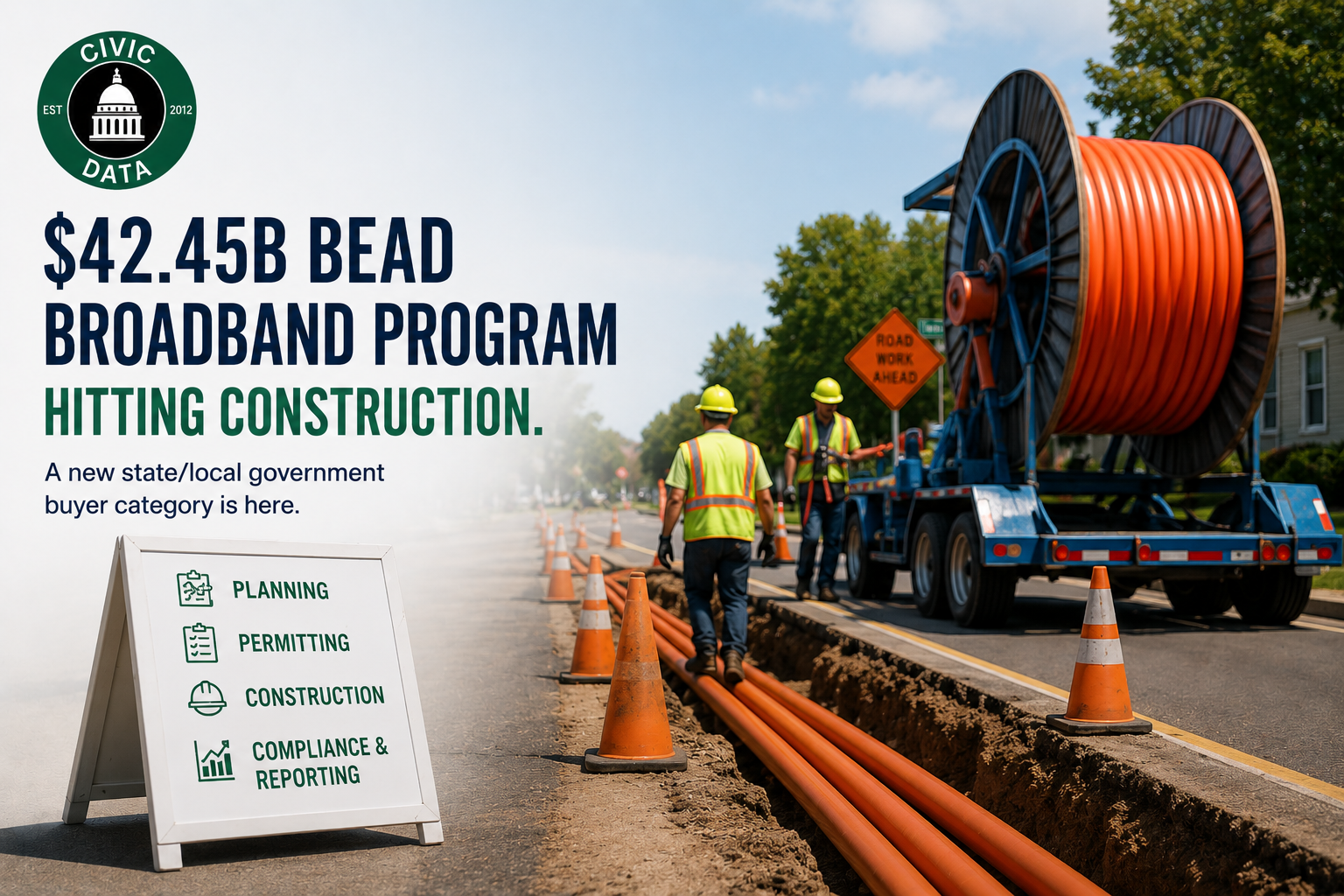
The $42.45 billion federal BEAD program has moved from planning into active construction across most states, creating a genuinely new category of state and local government buyer that most civic mailing lists have not yet separately identified.
The $42 Billion BEAD Broadband Buildout Has Reached Construction, and It Just Created a New Category of Local Government Buyer
The Broadband Equity, Access, and Deployment program, better known as BEAD, is the largest broadband infrastructure investment in American history, and for most of its life it has existed mainly as paperwork. All 56 states and territories submitted their required Final Proposals, and as of this summer 54 have received NTIA approval, 52 have cleared the additional review that makes their grant funds available, and 52 have signed and returned their award agreements. That process took nearly three years. It is now over in most of the country, and the $42.45 billion program has shifted from planning documents into trenching crews, pole attachments, and network activation projects.
That shift matters enormously for anyone selling into state and local government, because BEAD's execution model concentrates real purchasing authority and program management responsibility inside a category of government office that most civic mailing lists have never treated as its own distinct segment.
How BEAD Actually Gets Built
BEAD is structured as a national program that is executed entirely at the state level. Each state received its own allocation, from roughly $147 million in Massachusetts up to more than $3 billion in Texas, and each state designed its own scoring criteria, ran its own subgrantee selection process, and now controls its own construction timeline. Most BEAD-funded construction will happen between 2026 and 2030, and Texas alone selected 22 applicants in December 2025 to serve more than 240,000 broadband-serviceable locations and over 2,700 community anchor institutions, with construction beginning this summer. A June 2025 restructuring notice from NTIA loosened some technology requirements, allowing states to fund fixed wireless and low-earth-orbit satellite solutions alongside traditional fiber, which has reshaped procurement conversations in nearly every state broadband office over the past year.
State legislatures have not been passive bystanders either. Pew's analysis found that 26 states allocated a combined $1.3 billion to their own broadband programs in 2025 alone, on top of BEAD, and more than 160 broadband-related bills and resolutions passed across state legislatures that same year. Idaho, Illinois, Indiana, and West Virginia all updated permitting rules specifically to speed up broadband construction timelines, since permitting delays and workforce availability have emerged as the two biggest barriers standing between an approved BEAD proposal and an actual fiber connection.
The New Purchasing Categories BEAD Construction Creates
BEAD-funded projects carry federal requirements that most state and local government purchasing has not dealt with at this scale before, including Build America, Buy America domestic sourcing rules, formal workforce development plans, and detailed ongoing compliance reporting. Most awards also require a minimum 25 percent non-federal match, which state broadband offices are frequently securing through a combination of private investment, state appropriations, and debt financing, creating a genuine financial structuring need on top of the engineering work. States are actively seeking engineering, procurement, and construction partners with specific experience navigating these compliance requirements, along with grant management and reporting software capable of tracking Build America Buy America documentation, workforce plan compliance, and the location-by-location progress reporting NTIA requires throughout the multi-year construction window.
What Execution Actually Looks Like State by State
The variation across states in how BEAD is being executed is itself a useful signal for anyone building a state-by-state outreach strategy. Virginia received approximately $1.48 billion and has approached its rollout through the lens of the Virginia Telecommunication Initiative, a public-private broadband grant mechanism the state has run since 2017, giving Virginia's broadband office a level of institutional experience most states are building from scratch. Pennsylvania was awarded $1.16 billion and has moved through its final proposal approval on a more traditional state-agency timeline. Massachusetts, despite a comparatively modest $147 million total allocation, approved an initial $18.8 million tranche in February 2026 targeting more than 2,500 unserved and underserved locations and over 1,200 community anchor institutions, illustrating how even smaller-allocation states are moving into real construction activity this year. States are also leaning differently on technology mix: some are pursuing an almost entirely fiber-first approach, while others are blending fiber with fixed wireless and low-earth-orbit satellite service, particularly Amazon's Kuiper constellation, to reach the most remote and expensive-to-serve locations at a lower cost per connection.
The workforce constraint underneath all of this construction activity deserves its own attention from any vendor selling into this space. Broadband deployment at this scale requires trained fiber technicians, permitting specialists, and project management capacity that most state broadband offices do not have in-house, which is precisely why experienced engineering, procurement, and construction partners have become such a critical bottleneck resource. States that have paired their BEAD execution with workforce development grants, training pipelines run through community colleges, and streamlined permitting processes are moving measurably faster than states still working through staffing and process constraints, and that gap is likely to widen through the peak 2027 to 2028 construction years.
The Buyer Map for This New Government Function
State Broadband Office Directors
Every state now has a formally resourced broadband office, sometimes called a Broadband Development Office or Broadband Equity Office, directly administering hundreds of millions to billions of dollars in federal grant funds with multi-year procurement and compliance responsibilities that simply did not exist for most of these offices before 2023. This is a newly powerful government contact with sustained purchasing authority running through the end of the decade.
County and Municipal Digital Equity Coordinators
Below the state level, county and municipal digital equity roles manage the last-mile relationship with community anchor institutions, schools, libraries, and healthcare facilities that BEAD is specifically designed to connect, and these coordinators frequently control local outreach, adoption, and digital literacy program budgets that run alongside the infrastructure spending itself.
Grant Compliance and Reporting Officers
The Build America Buy America sourcing documentation, workforce development plan compliance, and ongoing NTIA progress reporting have created real demand for a compliance-specific role inside state broadband offices, one that most civic mailing lists have never separately identified from the broadband office director.
Schools sit directly inside this buildout as eligible community anchor institutions, connecting BEAD's execution phase directly to the technology directors K12 Data already tracks as districts wait on last-mile connections in unserved and underserved areas. Community colleges and universities administering workforce training grants tied to the broadband construction labor shortage represent exactly the kind of new administrative and financial aid function College Data has documented emerging around adjacent federal funding programs. Rural health clinics and hospitals, also designated as community anchor institutions under BEAD, connect this infrastructure buildout to the independent and rural practice technology adoption Physician Data tracks closely as telemedicine access expands into newly connected areas. And the wave of new digital equity coordinator and broadband compliance positions state and local governments are actively filling right now is precisely the kind of newly created government role K12 Talent's research on administrative hiring for structurally new positions has documented playing out across other sectors facing the same kind of federal funding-driven staffing pressure.
What Vendors Should Be Doing Right Now
- Build state Broadband Office Director and county or municipal Digital Equity Coordinator into your government mailing list as distinct, high-priority contacts, separate from general IT or public works titles.
- Track each state's Final Proposal approval and award agreement status closely, since construction procurement activity accelerates sharply the moment a state moves from approval into the signed-agreement stage.
- Develop specific messaging around Build America Buy America compliance and workforce development plan documentation, since this is a genuinely new procurement requirement most government vendors have not had to address at this scale before.
- Watch state legislative sessions for permitting reform activity, since states actively streamlining their permitting process are signaling they intend to accelerate construction procurement ahead of peers still working through a slower process.
Why the Timing Window Matters Right Now
Most BEAD-funded construction is expected to run through 2030, but the procurement decisions determining who wins that construction work, and which software and service vendors those winning contractors rely on, are concentrated far more heavily in this earlier 2026 to 2027 window as states finalize subgrantee relationships and stand up their compliance infrastructure. A vendor who waits until construction is already underway everywhere has missed the moment when state broadband offices are actively evaluating new engineering partners, compliance platforms, and reporting tools rather than executing against contracts and vendor relationships that are already locked in. The states still finishing their award agreement process this year represent the clearest near-term opportunity, since their procurement decisions are still actively in motion in a way that a state already several months into construction is not.
Conclusion
BEAD has spent nearly three years as a planning exercise, and that phase is now largely over. With the overwhelming majority of states approved, funded, and under signed award agreements, the program has entered its execution phase, and execution means active procurement running through 2030 inside a newly resourced category of state and local government office. Vendors who have identified the state broadband office director and the county or municipal digital equity coordinator as distinct purchasing contacts are reaching real, sustained authority over one of the largest infrastructure investments in American history. Vendors still treating broadband as a generic IT category inside general government mailing lists are missing where this money is actually being spent.
K12 Data -- Build a List | Pricing | Blog College Data -- Build a List | Pricing | Blog Physician Data -- Build a List | Blog Civic Data -- Build a List | Blog K12 Talent -- Post a Job | Search Jobs | Blog