
How to Use Government Contact Data for Outreach Campaigns

 Federal Agencies
  0
0
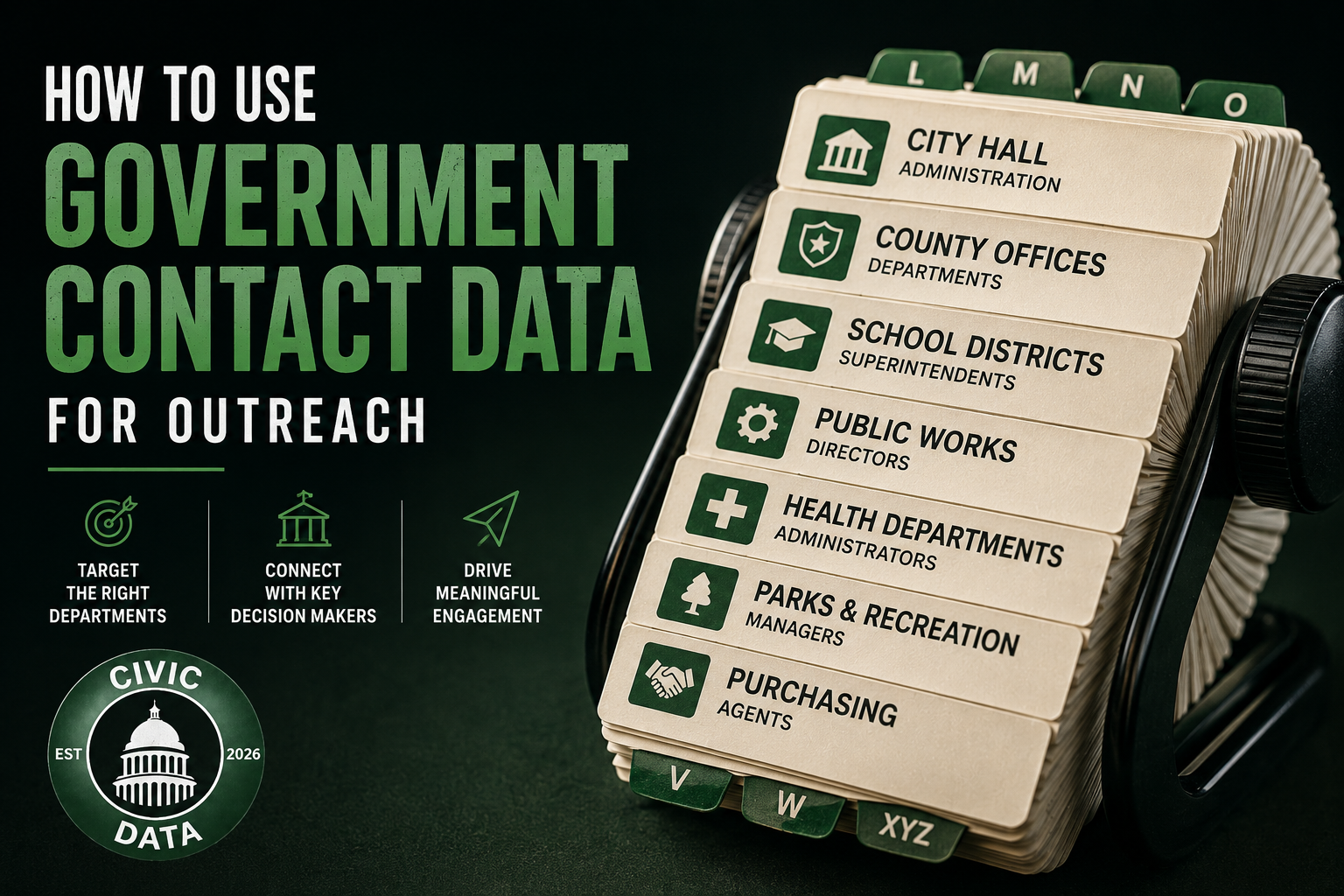
Government outreach requires the right contacts, the right timing relative to budget cycles, and messages calibrated to public sector decision-making. Here is how to use government contact data to reach municipal, county, and state buyers effectively.
How to Use Government Contact Data for Outreach Campaigns
By Charles Isham, Founder and CEO, Civic Data | civic-data.com
Selling to government is unlike selling to any other market. Public sector buyers operate under procurement rules that limit how vendor relationships can be initiated, budget cycles that do not align with most corporate fiscal calendars, and decision-making processes that involve more stakeholders, more documentation, and more time than almost any private-sector equivalent.
And yet government represents one of the largest and most stable B2B markets in the country. State and local governments collectively spend over $3 trillion annually, with significant portions going to technology, professional services, infrastructure, healthcare, and public safety vendors who have learned how to navigate the public sector buying process effectively.
This guide covers how to use government contact data for outreach campaigns: who the actual decision-makers are across different jurisdiction types and budget categories, how government procurement cycles work and when outreach is most effective, what compliance requirements apply to government vendor outreach, and how to build the contact list that makes all of this possible.
For comparison with physician outreach strategy across another regulated professional audience, see The Complete Guide to Physician Email Lists at physician-data.com.
Who Are Government Decision-Makers and Who Controls the Budget
Government purchasing authority is distributed across multiple layers of jurisdiction and agency function in ways that differ significantly from corporate purchasing structures. Understanding which contact type controls or influences each category of purchase is the foundation of effective government outreach.
At the municipal level, mayors and city managers set strategic direction and often have direct involvement in major vendor selections, particularly for technology, public safety, and infrastructure. Finance directors and city administrators control budget allocation and are involved in most significant purchase approvals. Department heads for public works, parks and recreation, information technology, human resources, and public safety manage operational budgets and initiate most department-level vendor relationships.
At the county level, county executives or administrators lead the jurisdiction. County commissioners or supervisors govern as a board and approve major budget items. Department directors for health, social services, public works, and technology are the operational decision-makers for most vendor categories.
At the state level, agency directors and their deputies control departmental budgets that can run into the hundreds of millions of dollars. Chief information officers manage statewide technology contracts. Procurement directors oversee the formal vendor qualification and contracting processes that vendors must navigate for significant state contracts.
"In government procurement, the person who signs the contract and the person who decides which vendor to use are rarely the same person. Outreach that reaches only one and not the other misses half of the decision-making process."
The Government Procurement Calendar and Outreach Timing
Federal, state, and local governments operate on different fiscal year schedules, which creates multiple budget windows throughout the calendar year rather than a single concentrated buying season. Federal agencies run on an October 1 to September 30 fiscal year with budget planning occurring in the spring and summer. Most state governments run July 1 to June 30 fiscal years with budget adoption in the spring. Local governments vary but often follow the same July-June cycle as their state.
The practical implication for government outreach is that effective campaigns are timed to reach decision-makers before their budget planning window closes, not after their budget is approved. For state and local governments, that means outreach aimed at influencing the following year's budget needs to reach decision-makers between September and January. For federal agencies, the equivalent window runs between February and June.
Government purchasing also occurs outside the planned budget cycle through grant funding, emergency appropriations, cooperative purchasing agreements, and end-of-fiscal-year spending. These create secondary outreach windows that sophisticated government vendors learn to anticipate and plan for alongside the primary budget cycle.
The end-of-fiscal-year window deserves particular attention. Government agencies that have unspent budget at the end of their fiscal year face use-it-or-lose-it dynamics that create compressed purchasing windows in the final weeks of the year. Vendors who have established relationships earlier in the year are well positioned to close business during these windows. Vendors who reach out for the first time in the final weeks rarely convert.
Segmenting a Government Contact List by Jurisdiction and Agency Type
Government contact data requires segmentation along dimensions that do not exist in private-sector databases: jurisdiction level, jurisdiction size, agency type, and the specific function category that aligns with the vendor's product. Generic outreach to government contacts without these segmentation dimensions produces poor results because government purchasing is more specialized by function than almost any private-sector equivalent.
Jurisdiction level segmentation separates municipal from county from state contacts, which matters because purchasing authority, budget size, and procurement process requirements differ significantly across these levels. A software solution priced at $15,000 may be a discretionary purchase for a county department director but require formal procurement for a small municipality. The same price point is a line item so small at the state agency level that it may not even require a formal PO.
Agency type segmentation within each jurisdiction level matches the vendor's product category to the government function it serves. Public safety technology vendors should target police chiefs, fire chiefs, and emergency management directors, not parks department administrators. Financial management software vendors should target finance directors and city controllers. Health and human services vendors should target county health directors and state public health officials.
• Public Safety and Emergency Management: Police chiefs, fire chiefs, emergency management directors, 911 center directors.
• Information Technology: CIOs, IT directors, cybersecurity officers, technology procurement coordinators.
• Finance and Administration: Finance directors, city controllers, budget analysts, procurement directors.
• Health and Human Services: County health officers, social services directors, public health administrators.
• Public Works and Infrastructure: Public works directors, city engineers, transportation directors, utilities managers.
• Parks, Recreation, and Community Services: Parks directors, community development directors, planning administrators.
Jurisdiction Size and Budget Capacity
Jurisdiction size is one of the most important segmentation variables for government outreach because it determines the budget available, the purchasing process complexity, and the decision-making structure that a vendor needs to navigate.
Large cities and counties with populations above 500,000 have professional procurement offices, formal vendor qualification processes, and purchasing thresholds that require competitive bidding above relatively low dollar amounts. The upside is large contract values. The downside is long sales cycles and significant compliance overhead for vendors who are not already qualified in the jurisdiction's vendor database.
Mid-size jurisdictions with populations between 50,000 and 500,000 represent the sweet spot for many government vendors: sufficient budget for meaningful contract values, less competitive than major metropolitan markets, and often able to move faster through procurement than the largest jurisdictions. Department directors in mid-size jurisdictions frequently have more direct purchasing authority than their counterparts in major cities.
Small jurisdictions with populations under 50,000 often lack dedicated procurement staff and have lower individual contract values, but are highly responsive to outreach from vendors who understand their specific constraints. Cooperative purchasing agreements, where multiple small jurisdictions pool purchases under a single contract, have become common in this segment and allow vendors to reach many small governments through a single qualified contract.
"Cooperative purchasing vehicles like NASPO ValuePoint, Sourcewell, and state-specific cooperative contracts have fundamentally changed the small and mid-size government market. A vendor with a cooperative contract can reach thousands of eligible government buyers without navigating individual procurement processes for each one."
Building a Government Email List: Sources and Standards
Government contact data is technically public information in most jurisdictions, but public availability does not mean it is compiled and maintained in a format useful for outreach campaigns. Government websites list staff directories with inconsistent completeness and update frequency. State open records databases contain organizational structures but often limited individual contact data. The manual effort required to compile usable government contact data from public sources at scale is prohibitive for most organizations.
Civic Data maintains a continuously verified database of government contacts at the municipal, county, and state levels across all 50 states, organized by jurisdiction type, agency function, and role. The database covers mayors, city managers, county executives, department directors, and their key deputies across the full spectrum of government functions relevant to vendor outreach.
Verification methodology for government contacts combines automated email deliverability testing with scheduled human review, which is necessary because government email systems often use address formats that automated tools struggle with. Government domain extensions (.gov, .us, state-specific domains) require verification approaches calibrated to public sector email infrastructure rather than private sector email systems.
When evaluating a government contact data vendor, ask about their coverage of specific jurisdiction types relevant to your market, their verification process for government domains, and their update cycle for capturing personnel changes. Government senior staff turnover is significant, particularly after election cycles when political appointees change and department leadership shifts in response to new administration priorities.
Compliance Considerations for Government Vendor Outreach
Government outreach operates under CAN-SPAM requirements like all commercial email, but the government market has additional compliance dimensions that matter for vendors building long-term public sector relationships.
Many state and local jurisdictions have ethics rules that govern how government employees can interact with vendors, including restrictions on accepting gifts, meals, or other items of value. Outreach campaigns that offer promotional items, entry into prize drawings, or other incentives as engagement mechanisms may create compliance issues for the government officials who receive them. The safest approach for government outreach is informational content with no attached incentives.
Some jurisdictions have implemented additional vendor registration requirements that must be completed before a company can respond to a solicitation or in some cases initiate outreach to government buyers. Understanding the registration requirements in your target jurisdictions is a prerequisite for government outreach programs in those markets.
Lobbying registration requirements can apply to vendors whose outreach involves advocating for specific policy positions or legislative action, as distinct from commercial product outreach. The distinction between commercial outreach and lobbying varies by state and is worth reviewing with legal counsel for vendors whose messaging touches on policy advocacy.
Campaign Strategy for Government Outreach
Government outreach campaigns that perform well share a common characteristic: they are designed around the specific information needs and decision-making context of government buyers rather than adapted from private-sector campaign templates. Government decision-makers respond to content that helps them do their jobs better, not content that positions a vendor's product against competitors.
Effective government outreach content includes case studies from peer jurisdictions of similar size and type, compliance and regulatory guidance relevant to the government function, cost savings or efficiency data expressed in terms that translate to government budget language, and resources that help government staff evaluate and justify technology purchases through formal procurement processes.
Multi-touch sequences for government outreach should be calibrated to the longer decision-making timelines typical of public sector procurement. A six to eight touch sequence over 10 to 12 weeks is appropriate for significant technology or service vendor relationships. Shorter sequences of three to four touches over four to six weeks work better for lower-cost products that can move through government purchasing without formal procurement.
Civic Data's government contact database is structured to support campaign segmentation by jurisdiction level, agency type, jurisdiction size, and geography, enabling the precise targeting that makes government outreach economically viable. Visit civic-data.com to explore the database and request a sample list for your target government market.
Frequently Asked Questions
What types of government contacts are included in a civic outreach database?
A comprehensive government contact database covers municipal contacts including mayors, city managers, and department directors; county contacts including county executives, commissioners, and department heads; and state agency contacts including agency directors, deputy directors, and key administrators. Civic Data covers all three jurisdiction levels across all 50 states.
How does government procurement affect outreach timing?
Government agencies plan budgets before their fiscal year begins, which means outreach to influence purchasing decisions needs to reach decision-makers three to six months before the fiscal year starts. For state and local governments on July 1 fiscal years, October through January is the primary budget planning outreach window.
What is the difference between a government email list and a government mailing list?
A government email list contains verified email addresses for digital outreach. A government mailing list contains verified physical addresses for direct mail campaigns. Civic Data provides both, and many government vendor campaigns use both channels for higher combined reach.
Are there compliance restrictions on emailing government officials for sales purposes?
CAN-SPAM compliance applies to government outreach as to all commercial email. Some jurisdictions have additional ethics rules that restrict government employees from receiving gifts or certain types of promotional outreach. Informational content without promotional incentives is the safest approach for government vendor outreach.
How do cooperative purchasing agreements affect government outreach strategy?
Cooperative purchasing vehicles like NASPO ValuePoint and Sourcewell allow vendors with qualifying contracts to reach thousands of eligible government buyers without individual procurement processes. For vendors who qualify for cooperative contracts, outreach communicating cooperative availability dramatically shortens the government sales cycle and expands reachable market significantly.
Related Resources Across the Data Portfolio
K12 Talent is the K-20 education job platform connecting school districts, colleges, and universities with verified educator contacts. School districts are government entities, and for HR and recruiting professionals in the public education sector, read K-12 Teacher Recruitment Strategies That Actually Work at k12-talent.com. Post a job or explore educator contacts at k12-talent.com.
K12 Data covers verified K-12 school and district contacts at k12-data.com. School districts are independent government entities, and the outreach strategies covered in How to Build a K-12 Email List for Outreach Campaigns complement government outreach strategies for vendors serving both markets. Build a K-12 contact list at k12-data.com/custom_databases.
College Data covers verified higher education administrator contacts at college-leads.com. Public colleges and universities are government-affiliated institutions, and the outreach strategies in How to Reach College Administrators with Email Campaigns are directly relevant to vendors in both markets. Build a higher education contact list at college-leads.com/custom_databases.
Physician Data covers verified healthcare professional contacts at physician-data.com. For government vendors whose products serve public health agencies, county health departments, or government health programs, read The Complete Guide to Physician Email Lists at physician-data.com. Build a healthcare contact list at physician-data.com/custom_databases.
Charles Isham is the founder and CEO of Civic Data and a portfolio of B2B data platforms covering education, healthcare, and government. A U.S. veteran with more than 15 years in education data, he oversees more than five million verified contacts across K-20 education, healthcare, and public-sector verticals. His platforms include K12 Data, College Data, Physician Data, Civic Data, and K12 Talent. Learn more at civic-data.com.