
Government Procurement Rules Just Got More Complicated, and It's Reshaping Who Approves a Tech Purchase

 Federal Agencies
  0
0
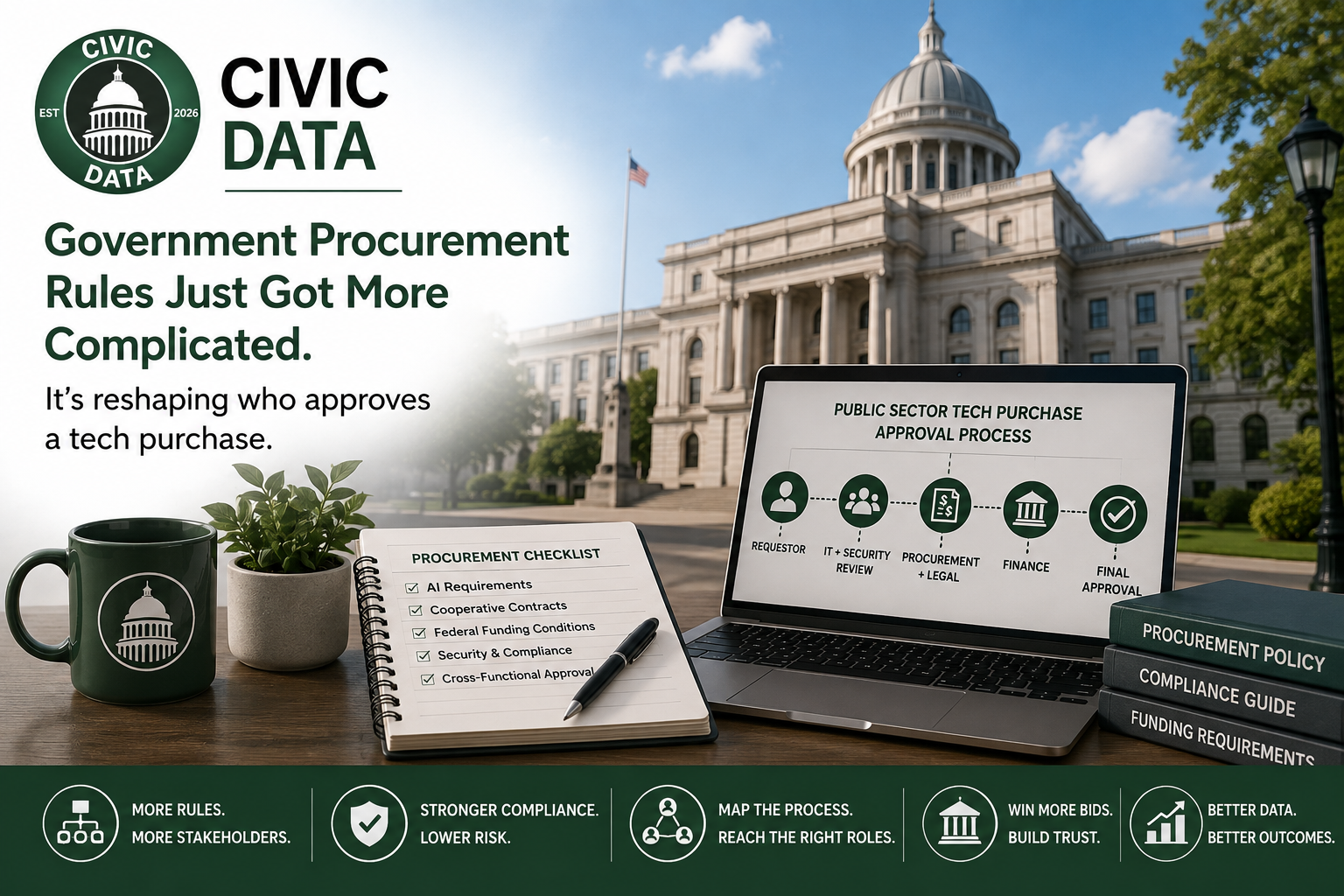
AI-specific requirements, cooperative contract mandates, and federal funding conditions are colliding, reshaping who inside government actually approves a technology purchase.
Government Procurement Rules Just Got More Complicated, and It's Reshaping Who Approves a Tech Purchase
Buying technology used to be a relatively contained decision inside state and local government, generally moving through a single procurement office following a fairly standardized process. That is changing quickly. New AI-specific procurement requirements, an expanding reliance on cooperative purchasing contracts, and federal funding conditions increasingly attached to technology spending are colliding at once, and the practical result is that public agencies genuinely cannot buy technology the same way they did even two years ago.
For vendors selling into government, and for the procurement, IT, and finance officials now navigating this shift, this is not a distant compliance concern. It is an active, current reshaping of who inside a given agency actually needs to sign off on a technology purchase, and how long that process now realistically takes.
Why Procurement Got More Complicated All at Once
Three distinct pressures are converging on government technology procurement simultaneously. AI-specific procurement requirements are emerging in a growing number of states, requiring agencies to evaluate and document AI-related risk, bias, and transparency considerations before purchasing a tool that incorporates AI capabilities, a category that now includes a meaningfully broad range of otherwise ordinary software products. Cooperative purchasing contracts, which let agencies leverage pre-negotiated pricing and terms established by another government entity rather than running an independent procurement process, have expanded considerably as a purchasing mechanism, but they come with their own eligibility and compliance requirements agencies must navigate correctly.
Federal funding conditions, increasingly attached to grants and other federal dollars flowing to state and local government, are adding a third layer of requirements agencies must satisfy specifically when federal funds are involved in a given technology purchase, requirements that can vary by specific funding source and that agencies must track correctly to remain compliant with the terms of that funding.
Why This Reshapes Who Approves a Purchase
Each of these three pressures pulls a different set of stakeholders into a purchasing decision that used to sit primarily with a procurement officer and a technology or program lead. AI-specific requirements are pulling legal counsel and, in a growing number of agencies, a dedicated AI governance or ethics reviewer into technology purchasing decisions earlier than these roles have traditionally been involved. Cooperative contract compliance is pulling procurement specialists with specific expertise in cooperative purchasing rules into a process that used to be handled more generically by whichever procurement staff member happened to be assigned to a given purchase.
Federal funding compliance is pulling grants management and finance staff into technology procurement decisions specifically when federal dollars are part of the funding mix, a coordination requirement that did not exist in this form when federal funding conditions attached to technology spending were less common and less specific than they have become recently.
"Government technology purchasing tends to move on two speeds: glacially slow until a mandate or deadline forces fast action."
The Practical Timeline Impact
Agencies navigating all three of these pressures simultaneously are seeing real, measurable extensions to how long a technology purchase actually takes from initial identification of a need to final contract execution. A purchase that might have moved through procurement in a matter of weeks under the previous, simpler process can now require sign-off from legal, a cooperative contract compliance review, and grants management coordination, each adding real time even when every individual reviewer is working efficiently and in good faith.
This timeline extension is a genuine operational challenge for agencies trying to respond to urgent needs, whether that is a cybersecurity gap requiring immediate remediation or a service delivery problem citizens are actively experiencing. Vendors selling into government need to understand this extended timeline realistically, building sales and implementation planning around the actual current procurement reality rather than the faster process that may have applied even two budget cycles ago.
Who Vendors Actually Need to Reach Now
Vendors serving this space need contact data that reflects this expanded stakeholder group accurately, not just the traditional procurement officer and department head who used to represent the full decision-making chain for most technology purchases. Legal counsel and AI governance reviewers, where that role exists, are increasingly relevant contacts for any technology product that touches AI capabilities in any meaningful way. Procurement specialists with cooperative contract expertise specifically are worth identifying separately from generalist procurement staff, since cooperative purchasing decisions frequently route through this more specialized function. And grants management staff deserve direct outreach for any technology purchase likely to involve federal funding, since their sign-off may now be a genuine, required step in the approval chain.
A government contact database that still reflects only the traditional procurement officer and department head structure is missing a meaningful and growing share of the actual approval chain most technology purchases now require, particularly for any purchase involving AI capabilities, cooperative contracts, or federal funding, which collectively represent a considerable and growing share of overall government technology spending.
What Agencies Themselves Are Doing to Adapt
Agencies navigating this complexity most effectively are building cross-functional procurement review processes specifically designed to route a given purchase through the right combination of reviewers based on its specific characteristics, rather than applying a single generic review process uniformly regardless of whether AI capabilities, cooperative contracts, or federal funding are actually involved in a particular purchase. This kind of triage approach, identifying early which specific reviews a given purchase actually requires, helps agencies avoid unnecessarily routing every purchase through every possible reviewer, which would extend timelines even further than the underlying complexity actually requires.
Agencies without this kind of structured triage process in place are frequently defaulting to routing every technology purchase through the most comprehensive possible review regardless of whether it is actually warranted, a genuinely inefficient response to this complexity that creates real, avoidable delay for purchases that may not have actually required AI governance review, cooperative contract compliance checking, or grants management coordination at all.
A Concrete Scenario Worth Walking Through
Consider a mid-size county evaluating a new case management platform for its social services department, a platform that incorporates AI-assisted case prioritization as one of several features. Under the previous, simpler procurement model, this purchase would likely have moved through a fairly standard process: department head identifies the need, procurement runs a competitive process or leverages an existing contract, finance approves the budget line, purchase completed.
Under the current landscape, this same purchase now genuinely requires additional steps. Because the platform incorporates AI capabilities, legal counsel or a dedicated AI governance reviewer needs to evaluate the tool against the county's AI procurement policy, documenting risk and bias considerations before purchase. If the county intends to acquire the platform through a cooperative purchasing contract rather than running an independent procurement process, a procurement specialist with specific cooperative contract expertise needs to verify eligibility and compliance with that specific contract's terms. And if any portion of the purchase is funded through a federal grant supporting the department's social services programming, grants management staff need to confirm the purchase satisfies whatever specific conditions that funding source attaches to technology spending.
None of these additional steps exists to create bureaucratic friction for its own sake. Each responds to a genuine, real risk, whether that is algorithmic bias in an AI-assisted tool making decisions that affect vulnerable populations, improper use of a cooperative contract the county was not actually eligible to access, or federal funding compliance violations that could jeopardize future grant eligibility. But the cumulative effect on timeline and stakeholder coordination is real and cannot be wished away simply because each individual requirement is well-intentioned.
Why Vendors Need to Understand This Timeline Reality Directly
Vendors selling into government who continue building sales cycles and implementation timelines around the simpler procurement process that applied even two years ago are setting themselves and their government customers up for genuine friction and frustration once the actual, current procurement reality asserts itself partway through a sales cycle. A vendor who can proactively address AI governance documentation requirements, cooperative contract eligibility questions, and federal funding compliance considerations as part of their standard sales process, rather than treating these as unexpected obstacles a government buyer surfaces partway through, demonstrates genuine understanding of how government actually buys technology today.
This proactive approach is increasingly becoming a genuine competitive differentiator in government sales specifically, since procurement, legal, and grants management staff navigating this more complex landscape genuinely appreciate vendors who arrive prepared to address these requirements directly, rather than vendors who require government staff to explain and walk them through requirements the vendor should have anticipated from prior government sales experience.
The Documentation Burden Nobody Budgeted Time For
Beyond the additional stakeholders now involved in a typical government technology purchase, the documentation burden itself has increased meaningfully, since AI governance review, cooperative contract compliance verification, and federal funding condition satisfaction all typically require formal, written documentation demonstrating the agency actually completed the required review, not simply that the review happened informally at some point in the process.
Agencies without dedicated staff time allocated specifically for this documentation burden are finding it consumes real capacity that was not previously required, often falling to whichever staff member happens to be coordinating a given purchase rather than being distributed across a role or team specifically resourced for this expanding function. This creates genuine demand for procurement workflow and compliance documentation tools specifically built to streamline this now-more-complex documentation burden, rather than requiring agencies to build ad hoc documentation processes from scratch for each individual purchase.
A Broader Pattern Playing Out Across Sectors This Year
This is not the only sector where a previously straightforward institutional process is suddenly requiring genuinely more complex, cross-functional coordination. K-12 districts are navigating a comparable coordination challenge from a different direction too, and K12 Data's glossary offers useful grounding in exactly the kind of terminology shift that accompanies a previously siloed function suddenly requiring broader cross-departmental fluency, the same pattern now playing out in government procurement. Higher education is facing a related coordination challenge from yet another direction, since full federal Gainful Employment and Financial Value Transparency requirements are forcing considerably closer coordination between institutional research, financial aid, and career services offices than most institutions previously maintained, a structurally similar cross-functional compliance challenge playing out in higher education.
Healthcare organizations are facing their own version of a fast-moving decision landscape requiring new coordination too, since a proposed 2027 Medicare fee cut is compressing physician practice ownership decisions onto a timeline that requires legal, financial, and clinical stakeholders to coordinate faster than usual. And K-12 hiring reflects a related structural shift too, since special education shortages are forcing districts to reach candidates through fundamentally different channels than the passive posting model most have relied on for years.
Government technology procurement has genuinely gotten more complicated, and the practical effect is a meaningfully expanded set of stakeholders who now need to be part of a technology purchasing decision that used to sit with a much smaller group. Vendors reaching this full, accurate stakeholder chain, legal counsel, AI governance reviewers, cooperative contract specialists, and grants management staff alongside the traditional procurement and technology leads, are positioned to navigate this complexity more successfully than those still selling into the simpler process that no longer fully reflects how government actually buys technology today.
Ready to reach the full range of decision-makers now involved in government tech procurement? Build a government marketing database, or buy a government email list, with Civic Data today.