
How to Tell If a Government Contact List Vendor Is Reselling Data They Don't Own

 Federal Agencies
  0
0
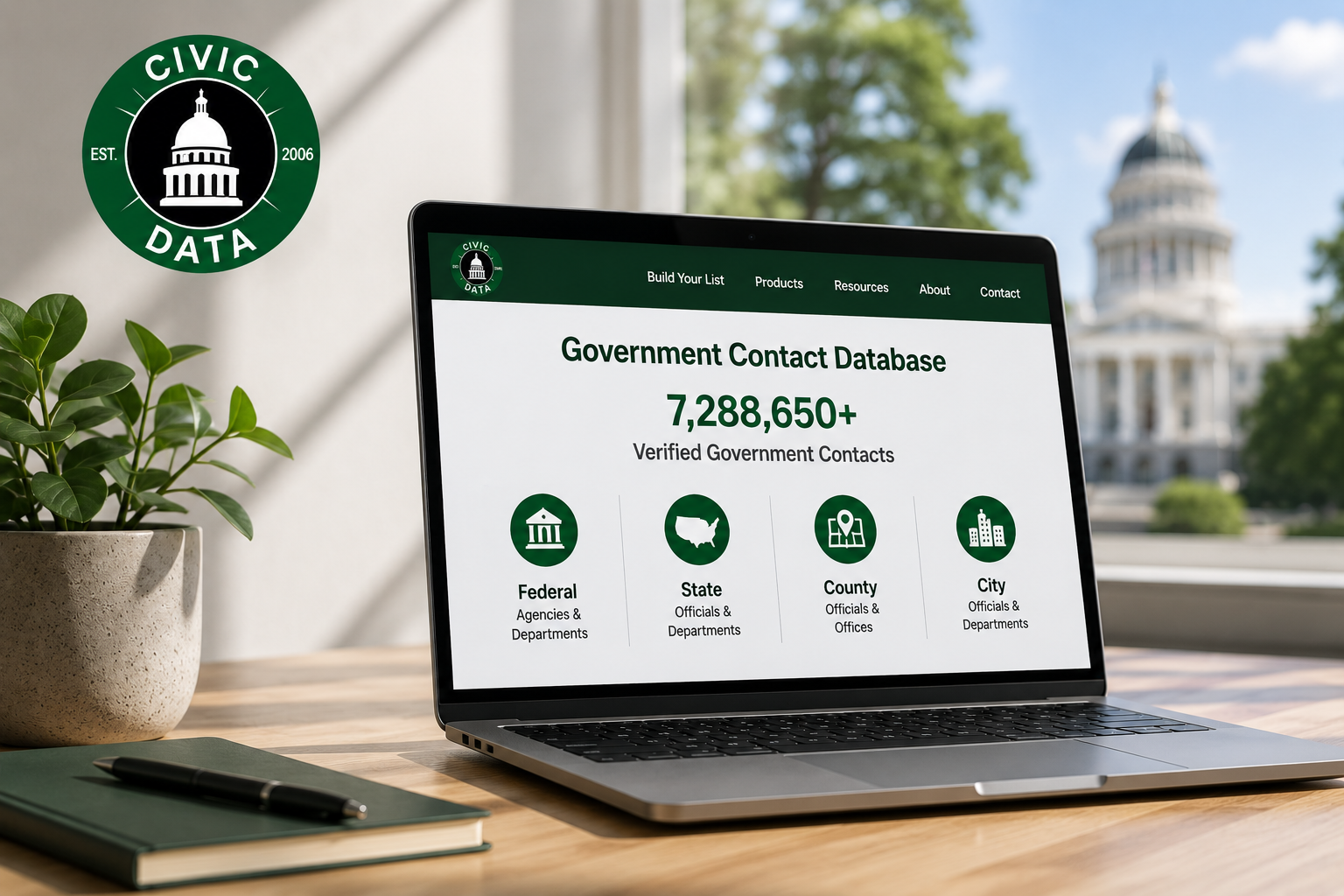
Most government contact list vendors are reselling or aggregating data they don't own. Here is how to tell, and why it matters for your B2G outreach results.
How to Tell If a Government Contact List Vendor Is Reselling Data They Don't Own
Search "government email list" and you will find dozens of vendors, most using nearly identical language: verified, opt-in, regularly updated, GDPR and CAN-SPAM compliant. That language tells you almost nothing about where the underlying data actually comes from, and the honest answer for a large share of the market is that the data was licensed from an upstream aggregator, relabeled, and marked up, not compiled directly from primary government sources at all, no matter how the marketing copy frames it.
Government contact data decays unusually fast even by B2B standards, with well over forty percent of local government contacts changing in a given year due to elections, retirements, and reorganizations. A resold list that was accurate when the upstream aggregator originally compiled it can be meaningfully wrong within months, and the reseller selling it forward has no direct mechanism to catch that decay, because they never had a direct relationship with the government agency in the first place, and never will as long as they remain dependent on someone else's original research.
Why Government Data Decays Faster Than Almost Any Other Vertical
Local and state government turnover runs on a genuinely different cycle than most B2B contact data, driven by election cycles, appointed-position turnover following new administrations, and frequent departmental reorganizations that can eliminate or rename roles with little public notice. A government administrator email list built even a year ago is statistically likely to contain meaningful errors before any external event forces the issue, simply because the underlying organizational structure keeps shifting on its own.
This fast decay rate makes the resale problem worse than it would be in a more stable vertical, because a reseller working from a licensed feed has no mechanism to catch changes between whatever refresh cycle their upstream source happens to run on. A compiler with a direct research relationship to government sources can catch and correct changes far faster, precisely because they are not dependent on someone else's update schedule that they do not control.
How to Identify a Reseller in a Sales Conversation
The same direct questions that reveal sourcing in any contact data vertical work here too, and they are worth asking explicitly rather than accepting vague reassurance. Ask whether the vendor compiles government contact data in-house or licenses it from another provider. A genuine compiler can describe their research process with real specificity, often citing exactly how they track elections, appointments, and departmental changes. A reseller tends to answer more vaguely, referencing "multiple trusted sources" or a "proprietary data blend" without naming a specific, traceable research process.
Ask how quickly the vendor's data reflects a recent election result or a publicly announced departmental reorganization. A compiler with direct research infrastructure will typically have a clear, specific answer about their update cadence relative to public news events. A reseller's honest answer usually traces back to whatever schedule their upstream aggregator happens to run on, which the reseller often does not fully control or even know with precision.
The Human-Verification Standard Some Vendors Actually Meet
A small number of vendors in the government contact space genuinely differentiate on verification method, and it is worth understanding what that looks like when done well. Some providers specifically emphasize phone-verifying every record and date-stamping changes, which is a meaningfully higher standard than a database that is only refreshed through periodic bulk re-scraping. Others emphasize human-verified data specifically, distinguishing their process from purely automated scraping or licensed feed aggregation.
These differences matter because they directly predict how a database performs against the fast-moving reality of government turnover described above. A phone-verified, date-stamped record is far more likely to reflect a genuinely current reality than a record pulled from a licensed feed that may have last been touched by anyone months or years earlier, regardless of how recently the reselling vendor themselves last "updated" their own copy of it.
Why This Costs More Than It Appears To
The real cost of resold or poorly verified government contact data rarely shows up as a line item. It shows up as a B2G campaign that gets a disappointing response rate, a sales team wasting outreach effort on officials who left office months earlier, or a procurement-focused pitch landing with a department that was reorganized out of existence before the campaign even launched. None of these failures get traced back to data sourcing in the moment, but sourcing is very often the actual root cause.
Government buyers themselves are increasingly aware of this dynamic from the other side, growing more skeptical of unfamiliar vendor outreach precisely because so much of the outreach they receive is built on stale or inaccurate data. A vendor whose outreach demonstrably reflects current, accurate organizational knowledge stands out immediately against this backdrop, while a vendor working from resold data risks actively damaging their own credibility with every mistargeted email.
What to Actually Do Before Your Next Purchase
Ask the sourcing question directly, and pay close attention to how specifically the vendor can answer it. Request a small test segment for a jurisdiction you know well enough to verify accuracy against personally, and check it before committing to a larger purchase. And treat unusually low pricing with real skepticism, since compiling and verifying government contact data at this level of freshness is genuinely expensive, and a price far below the market average most often reflects skipped verification work, not a discovered efficiency. A vendor unwilling to let you test a small sample before a larger commitment is itself a signal worth taking seriously, regardless of what else they say during the sales process.
The Aggregation Chain in Government Data Specifically
Government contact data moves through the market via a similar chain to other verticals, but with an added complication: much of it originates from public records that are themselves inconsistently maintained across different jurisdictions, agencies, and levels of government. An initial aggregator scrapes or requests public directory information from thousands of individual government websites, each with different formatting, different update cadences, and different levels of accuracy in the first place. That aggregated dataset then gets licensed downstream to resellers, who repackage and resell it forward, sometimes through multiple additional layers, with each layer adding marketing polish but no additional verification.
By the time a buyer encounters a reseller several layers removed from the original public records, the data may reflect a snapshot of government websites from months or years earlier, filtered through several rounds of relabeling with no fresh verification at any point in the chain. Two vendors selling what appears to be a comparable municipal contact database at similar prices may be selling variations of the exact same aggregated dataset, neither one able to meaningfully improve on what the original aggregator captured.
Election Cycles Make This Problem Acute
Government contact data faces a specific decay pressure that most other verticals do not: predictable, large-scale turnover tied to election cycles. Local elected officials and many appointed positions change hands in a compressed window following even-year elections, and new officials typically spend their first several months building relationships and vendor connections essentially from scratch. A resold list that was accurate before an election cycle can become substantially wrong within weeks of a new administration taking office, and a reseller working from a licensed feed has no direct mechanism to update quickly enough to catch that specific, predictable wave of change.
A genuine compiler with real research infrastructure can build election-cycle monitoring directly into their update process, since the timing of these turnovers is publicly known well in advance. A reseller dependent on an upstream aggregator's schedule has no comparable ability to anticipate and prepare for this predictable disruption, which means their data is often at its least accurate during precisely the window when government buyers are most actively building new vendor relationships and most receptive to outreach from a vendor who can reach them accurately.
What Genuine Compilation Requires in This Sector
Compiling government contact data well requires tracking public records across an enormous number of individual jurisdictions, each with its own website, its own update practices, and its own level of organizational transparency. This is genuinely labor-intensive work, and it is precisely the kind of work that gets skipped when a vendor chooses to license an existing feed rather than build original research infrastructure.
A vendor doing this well typically maintains ongoing monitoring processes tied to election calendars, tracks publicly announced departmental reorganizations as they happen, and builds direct verification relationships wherever possible rather than depending entirely on periodic website scraping. This is a meaningfully higher-cost operating model than reselling a licensed feed, which is exactly why so few vendors in this space actually do it, and exactly why the ones who do it well represent a genuinely smaller category than the market's overall vendor count would suggest.
This Problem Runs Across Every Sector We Serve
The resale and aggregation problem is not unique to government contact data. K-12 buyers face an identical challenge, since most school email list vendors use the exact same reassuring language while sourcing their data through very different processes, and the same due-diligence questions apply directly. Higher education contact data shows the same pattern in a different form, since a database built and verified across a connected K-20 continuum catches errors and changes that a single-purpose vendor's narrower feedback loop simply cannot.
K-12 hiring platforms demonstrate the same underlying principle from yet another angle, since a platform built on direct relationships with millions of verified educators consistently outperforms one relying on passive job postings alone. And physician contact data faces this exact challenge too, since a database that cannot keep pace with how quickly physicians move between practice settings reveals the same sourcing and verification gap through a different symptom entirely.
Government contact data decays faster than almost any other B2B vertical, which makes the resale and aggregation problem more costly here than almost anywhere else in the contact data market. Buyers who ask direct sourcing questions before purchasing, rather than discovering the answer through a disappointing campaign afterward, consistently end up with data that actually reflects the government workforce as it exists today, not as it existed whenever an upstream aggregator last touched it.
Ready to reach government decision-makers with data that is actually verified, not resold? Build a government marketing database, or buy a government email list, with Civic Data today.
K12 Data — Build a List | Pricing | Blog College Data — Build a List | Pricing | Blog Physician Data — Build a List | Blog Civic Data — Build a List | Blog K12 Talent — Post a Job | Search Jobs | Blog