
The Municipal Fiscal Convergence Crisis Is Making City CFOs and Finance Directors the Most Actively Purchasing Government Contacts Nobody Is Reaching

 Federal Agencies
  0
0
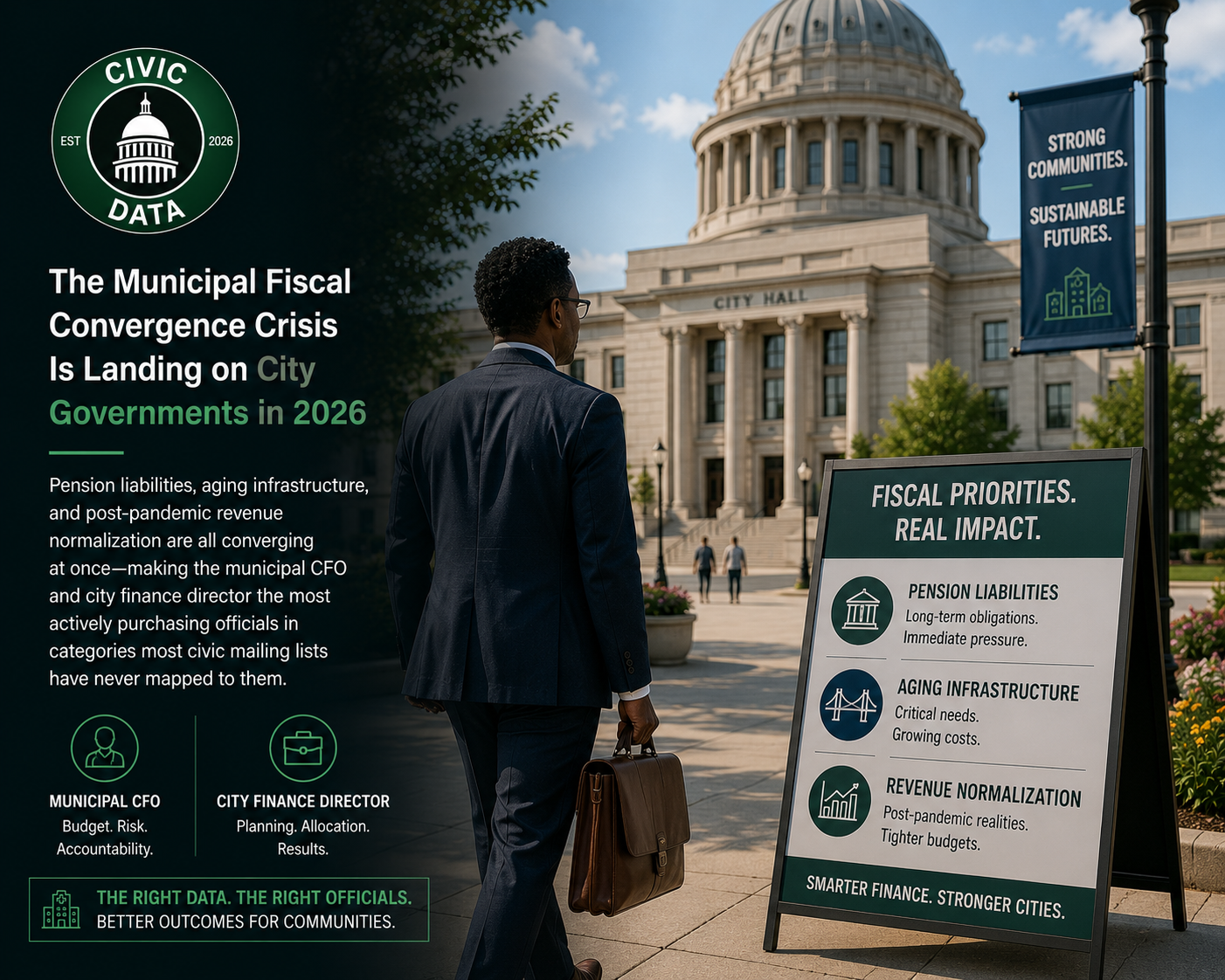
Pension liabilities, aging infrastructure, and post-pandemic revenue normalization are converging on city governments in 2026 — making city CFOs the most actively purchasing government contacts most civic mailing lists are not reaching.
The Municipal Fiscal Convergence Crisis Is Making City CFOs and Finance Directors the Most Actively Purchasing Government Contacts Nobody Is Reaching
The government vendor market conversation in 2026 is dominated by federal restructuring, state AI governance, and SLED procurement shifts. What is not getting the attention it deserves — and what is generating some of the most active purchasing conversations in the public sector right now — is the municipal fiscal convergence crisis: the simultaneous landing of pension liabilities, aging infrastructure, post-pandemic revenue normalization, and Medicaid-related cost shifts on city governments that were not financially prepared to absorb all of them at once.
For vendors selling financial management software, asset management platforms, infrastructure services, actuarial consulting, and fiscal advisory tools to local government, this crisis represents a concentrated and time-sensitive purchasing opportunity. The city CFOs, finance directors, budget officers, and city administrators managing the convergence are making vendor evaluation decisions under fiscal urgency that the standard government procurement calendar does not produce in stable periods. And they are making them in a purchasing category — municipal financial management and fiscal advisory services — where most government mailing lists and civic mailing lists have never specifically mapped the city finance director as a primary, high-priority outreach contact.
Government outreach strategies are overwhelmingly built around program director and technology contacts — the officials managing service delivery and IT infrastructure. The fiscal management layer — the city CFO, the city budget director, the pension fund administrator, the infrastructure finance officer — has historically been a secondary contact tier in most civic workforce data and municipal email list strategies, because fiscal management purchases were episodic, large, and typically procurement-driven through highly structured RFP processes. The convergence of multiple fiscal pressures in 2026 has changed that dynamic. City financial leadership is not waiting for a stable planning environment to begin vendor evaluation. They are evaluating vendors under urgency.
The foundational analysis of how municipal government fits into the broader public sector vendor opportunity — and how the federal cost shift is making local government the most actively purchasing tier — is documented in Government Workforce Data: Public Sector Outreach, Sales and Hiring and Government Email List and Workforce Data: Public Sector Marketing — both of which establish the framework for understanding why local government requires distinct, tier-specific contact data strategies rather than undifferentiated public sector mailing lists.
Market Overview: The Three Fiscal Pressures Converging on Municipalities in 2026
Pension liability maturation. Municipal pension obligations that accumulated during years of lower contribution rates and optimistic investment return assumptions are maturing in 2026 at a moment when many municipal budgets were already strained by the end of pandemic-era federal relief spending. The gap between pension fund assets and actuarially determined pension liabilities — the unfunded actuarial accrued liability — has grown at hundreds of municipalities simultaneously, creating required contribution increases that are consuming percentage points of operating budgets that were previously available for services and capital investment. The city CFO and pension fund administrator evaluating actuarial consulting firms, liability management platforms, and pension obligation bond advisory services are making those vendor decisions under this convergence pressure.
Infrastructure replacement urgency. Decades of deferred maintenance on water systems, roads, bridges, public buildings, and utility infrastructure is creating replacement urgency that the Infrastructure Investment and Jobs Act partially funded but did not fully address. Municipalities that received federal infrastructure grants are managing project delivery timelines, procurement compliance requirements, and construction cost inflation that require project management platforms, grant compliance technology, and infrastructure asset management systems they did not previously need to operate at scale. The city public works director and the city infrastructure finance officer are making vendor decisions for these categories with federal grant timelines creating urgency that standard procurement calendars do not produce.
Post-pandemic revenue normalization. The revenue environment that sustained municipal budgets through 2023 and 2024 — federal pandemic aid, elevated sales tax receipts from inflation-driven consumer spending, strong real estate transfer tax revenues — has normalized. At the same time, the service delivery commitments made during years of strong revenue are not being reduced at the same pace. The result is a structural revenue-expenditure gap at hundreds of municipalities that is generating financial planning, revenue forecasting, and fiscal advisory vendor conversations across city finance departments simultaneously. The city CFO evaluating new financial planning platforms and fiscal advisory relationships in response to this structural gap is in active purchasing mode — and largely unreachable by government mailing lists built around program and technology contacts.
The convergence of all three pressures at the same time is creating a municipal fiscal stress environment that is producing more active vendor evaluation in financial management, advisory, and infrastructure categories than the municipal market has generated in years. And the contacts managing that evaluation — city CFOs, finance directors, budget officers, pension administrators, and infrastructure finance officers — are systematically underrepresented in the government marketing lists and municipal email lists most vendors are using to reach city government buyers.
The Municipal Fiscal Purchasing Authority Map: Who Controls These Decisions
City CFOs and Finance Directors. The primary purchasing authority for financial management platforms, fiscal advisory services, actuarial consulting, and pension liability management tools. At most municipalities, the CFO or Finance Director holds independent purchasing authority for the vendor categories most directly affected by the fiscal convergence — financial software subscriptions, advisory service relationships, and analytical platform licenses that fall within their departmental budget mandate. A municipal email list or government mailing lists strategy that does not include city CFOs as a distinct, primary contact tier is missing the highest-authority buyer for the most actively purchasing category in city government right now.
City Budget Directors and Budget Officers. The city budget director manages the annual budget process that is simultaneously more complex and more constrained in 2026 than in recent years — incorporating pension contribution requirement increases, infrastructure funding allocations, and federal grant compliance requirements alongside baseline service delivery budgets. Budget directors are purchasing financial planning platforms, budget management software, and scenario modeling tools that enable them to manage increased budget complexity with limited staff capacity. This contact is distinct from the CFO and holds independent purchasing authority for the budget technology category.
Pension Fund Administrators and Retirement System Directors. At municipalities that administer their own pension systems — as opposed to participating in statewide public employee retirement systems — the pension fund administrator or retirement system director holds purchasing authority for actuarial consulting, investment advisory services, liability management analytics, and pension obligation reporting technology. These contacts have rarely appeared on any municipal email list or civic workforce data product because their purchasing occurred infrequently and through formal procurement processes. The pension liability maturation crisis is making their purchasing both more frequent and more urgent.
City Infrastructure Finance Officers and Capital Program Directors. Federal infrastructure grants require capital project management and grant compliance documentation infrastructure that most city public works and finance departments did not maintain before the IIJA funding wave. The infrastructure finance officer or capital program director managing federal grant compliance, project delivery tracking, and construction cost management is purchasing project management platforms, grant compliance tools, and asset management systems. These are contacts that most government mailing lists and civic mailing lists have never specifically included as high-priority targets.
City Administrators and City Managers with Fiscal Mandate. At municipalities operating under the council-manager model — where a professional city manager serves as the chief administrative officer — the city manager and assistant city managers hold strategic authority over the vendor relationships that address fiscal convergence challenges. City managers who arrived in the last two years are in their highest-receptivity vendor evaluation window and are building the advisory relationships that will inform their tenure's fiscal management approach.
The complete framework for how municipal government decision-making authority is structured — and how it connects to county and state government layers — is documented in Government Decision-Maker Map: Who Buys What — the most comprehensive treatment of public sector purchasing authority available.
Use Cases: Which Vendor Categories Are Most Active in the Municipal Fiscal Convergence Market
Financial management and ERP platform vendors. The municipal financial management software market — enterprise resource planning systems for government, financial reporting platforms, and revenue management tools — is in an active upgrade cycle driven by the complexity of managing pension liability tracking, federal grant compliance, and multi-fund accounting simultaneously. City CFOs and finance directors evaluating ERP upgrades in the context of fiscal convergence pressure are active buyers with urgency. Government mailing lists that reach these contacts directly — rather than routing financial software outreach through technology directors and IT leadership — are accessing the primary purchasing authority for this category.
Actuarial consulting and pension advisory firms. Cities experiencing pension liability maturation are evaluating actuarial consulting relationships, pension obligation bond advisory services, and liability management strategies with urgency that the stable pension environment of previous years did not produce. The pension fund administrator and city CFO are the purchasing contacts — and they are almost entirely absent from government marketing lists built around program and technology contacts.
Infrastructure asset management and grant compliance platforms. Federal infrastructure grants require asset inventory documentation, project delivery tracking, federal reporting compliance, and construction cost management infrastructure. The city infrastructure finance officer and capital program director are purchasing these platforms with federal grant timelines creating urgency that standard procurement cycles do not generate. A government mailing list strategy that reaches public works directors without reaching infrastructure finance officers is missing the contacts who control the compliance technology purchasing for the largest capital program category in municipal government.
Healthcare and Medicaid cost shift consequences at the city level. Municipalities that operate public health departments, city hospitals, or school-based health programs are facing the downstream consequences of Medicaid cuts that are landing on their operating budgets alongside the pension and infrastructure pressures already in place. City public health directors and municipal health administrators are actively seeking vendor relationships that help them manage service delivery with reduced Medicaid reimbursement — connecting the healthcare B2B outreach market to the municipal government contact data market in ways that organizations maintaining both physician mailing lists from Physician Data and government mailing lists from Civic Data are positioned to serve. Build a physician list | Physician Data blog.
Education funding crossover at the municipal level. In cities with municipal school systems — where the city budget directly funds K-12 education — the municipal fiscal convergence is compounding K-12 budget pressure simultaneously. City CFOs at municipalities with school budgets are co-evaluating financial planning tools with school district CFOs who are managing post-ESSER fiscal stress. Organizations with school mailing lists from K12 Data alongside government mailing lists from Civic Data understand how the municipal and school district fiscal pressures overlap at the city level. Build a K-12 list | K12 Data blog.
Data Strategy: Building Civic Mailing Lists That Reach Municipal Finance Leadership
- City CFO and Finance Director as mandatory primary contact tiers for financial management, advisory, and fiscal planning vendor outreach — not secondary contacts subordinate to program director and technology outreach
- City Budget Director as a distinct technology purchasing contact for budget management software and financial planning platform vendors — separate from the CFO contact and with distinct evaluation criteria
- Pension Fund Administrator and Retirement System Director as a high-priority contact for actuarial consulting and liability management vendors — a contact category almost entirely absent from standard civic mailing lists
- Infrastructure Finance Officer and Capital Program Director as active buyers for grant compliance technology and asset management platforms — traceable through federal IIJA grant recipient data
- Fiscal stress indicators — municipal credit ratings, unfunded pension liability ratios, post-pandemic revenue gap analysis — as targeting signals that identify the highest-urgency buyers within the municipal contact database
ROI: What Municipal Finance Contact Precision Delivers
The ROI case for building civic mailing lists and government contact databases that reach city CFOs and municipal finance directors as primary contacts rather than secondary approvers is driven by the same competitive dynamics that exist wherever a purchasing authority is systematically underrepresented in vendor outreach — low outreach volume, high receptivity, and minimal incumbent vendor competition in the relationship-building phase.
City CFOs managing the fiscal convergence crisis are actively looking for vendor partners — advisory firms, technology vendors, and consulting organizations that understand the specific combination of pension liability management, infrastructure finance, and revenue normalization they are navigating simultaneously. They are not receiving targeted outreach calibrated to their specific challenges from most vendors whose government mailing lists route outreach through program and technology contacts. The vendor who reaches the city CFO directly, with messaging that demonstrates understanding of the fiscal convergence dynamics the CFO is managing, is entering a purchasing conversation that the program-director-contact strategy never enables.
- Higher response rates from city CFO contacts because municipal finance directors receive far less targeted vendor outreach than the program and technology contacts that dominate most government mailing list strategies
- Faster evaluation timelines because fiscal urgency compresses the deliberation process that stable municipal budgets allow — CFOs managing pension liability maturation and infrastructure funding deadlines are not running 18-month procurement processes
- Better advisory service conversion because city CFOs evaluating actuarial consulting and fiscal advisory relationships are making those decisions at the executive level without committee evaluation processes that technology purchases require
- Stronger cross-sector outcomes for organizations that integrate municipal finance contacts with county government contacts, state government contacts, and K-12 school district finance director contacts across the overlapping fiscal stress environments
Trends: Where Municipal Fiscal Convergence and Government Procurement Are Headed Through 2027
Pension obligation bonds will drive advisory and capital markets vendor activity. As municipalities seek to manage unfunded pension liabilities, pension obligation bonds — which allow cities to issue taxable debt and invest the proceeds to cover pension obligations — are becoming an increasingly common fiscal tool. The advisory relationships that inform pension obligation bond decisions involve investment bankers, actuarial consultants, bond counsel, and financial advisors in a coordinated engagement that requires reaching multiple specialized contacts across the municipal finance function. Civic mailing lists that distinguish pension fund administrator contacts from general finance director contacts are supporting multi-contact outreach strategies for this advisory category.
Federal infrastructure grant compliance will drive a sustained technology purchasing wave. The Infrastructure Investment and Jobs Act is distributing hundreds of billions of dollars to state and local governments on implementation timelines that extend through 2026 and beyond. The grant compliance, project management, and asset tracking technology requirements this creates for municipal recipients are not one-time purchases — they are ongoing operational needs for the duration of the infrastructure programs. Infrastructure finance officers and capital program directors who purchased initial compliance technology in 2024 and 2025 are evaluating performance and considering upgrades or replacements in 2026.
AI will enter municipal financial management — creating a new governance contact in the finance function. As AI-assisted financial forecasting, revenue projection, and budget scenario modeling tools are introduced to municipal finance departments, the AI governance mandate documented in Role-Based Targeting: Government, Education and Healthcare Marketing will create AI oversight requirements at the municipal finance function level. City CFOs evaluating AI-assisted financial management tools will need to coordinate with the emerging municipal AI governance contacts that most civic mailing lists do not yet contain alongside the finance leadership contacts that are their primary targets.
Conclusion
The municipal fiscal convergence of pension liabilities, aging infrastructure, and post-pandemic revenue normalization is creating active purchasing urgency at city governments across the country — in financial management, advisory services, pension consulting, infrastructure finance, and asset management vendor categories that were previously episodic purchasing events. The contacts managing this purchasing — city CFOs, finance directors, budget officers, pension administrators, and infrastructure finance officers — are making vendor evaluation decisions under fiscal urgency that standard government procurement timelines do not produce.
And they are systematically absent from the government mailing lists and civic mailing lists that most vendors are using to reach city government buyers. Government outreach built around program directors and technology contacts is reaching the service delivery layer of city government — not the financial management layer that is making the most active vendor decisions in the fiscal convergence environment. The organizations that build civic workforce data strategies that include municipal finance leadership as primary, high-priority contact tiers — not secondary approvers subordinate to program contact outreach — are entering purchasing conversations that competitors routed through program contacts are not having.
Explore accurate government mailing lists and civic workforce data at Civic Data — Build a List | Pricing | Blog. For K-12 education contact data, visit K12 Data — Build a List | Blog. For higher education data, visit College Data — Build a List | Blog. For healthcare outreach, visit Physician Data — Build a List | Blog. For K-20 and government hiring, visit Peertopia — Post a Job | Search Jobs | Blog.