
Short-Term Rental Regulation Has Become One of the Busiest New Policy Areas in Local Government -- and Most of the Officials Running It Are Brand New to the Job

 Federal Agencies
  0
0
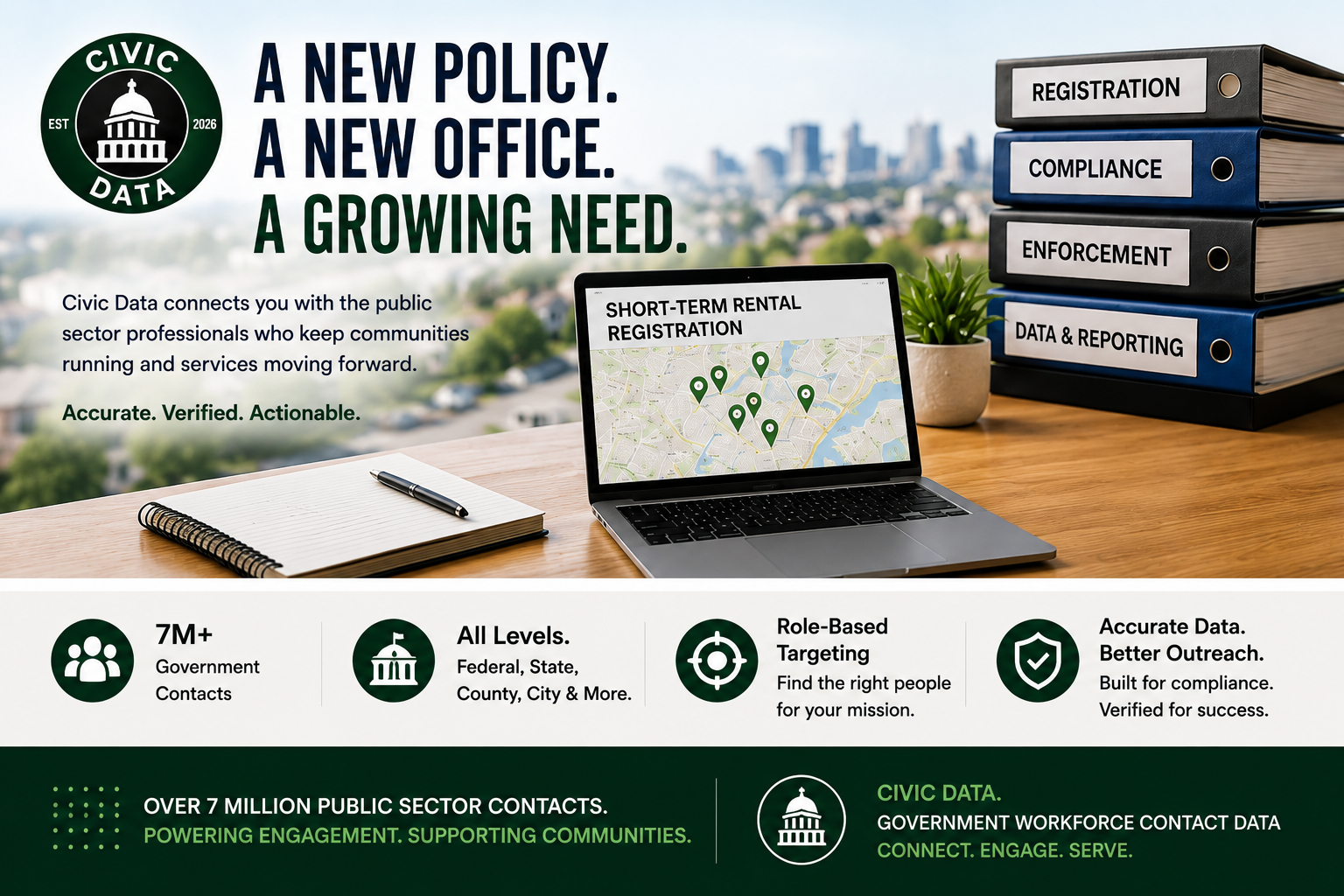
Hundreds of cities and counties have stood up short-term rental regulatory programs in just a few years, creating a new municipal function staffed by officials in roles that frequently did not exist three years ago.
Short-Term Rental Regulation Has Become One of the Busiest New Policy Areas in Local Government -- and Most of the Officials Running It Are Brand New to the Job
Over the past several years, hundreds of cities and counties across the country have stood up formal short-term rental regulatory programs essentially from scratch -- registration requirements, compliance tracking systems, enforcement coordination, and the administrative infrastructure needed to manage what has become one of the busiest and most politically charged new policy areas in local government.
This is a genuinely new municipal function in most jurisdictions that have adopted it. And the officials staffing it are, in a meaningful share of cases, brand new to roles that simply did not exist three years ago -- which means the government mailing lists most vendors are using have almost no coverage of this contact category.
Why Short-Term Rental Regulation Exploded as a Policy Area
The growth of platforms like Airbnb and VRBO over the past decade created a genuine and growing tension at the local government level between the economic benefits short-term rentals bring to a community -- tourism revenue, property owner income, hospitality tax collection -- and the real concerns that residents, neighborhood associations, and affordable housing advocates have raised about the effect of short-term rental concentration on housing availability, neighborhood character, and noise and nuisance complaints.
That tension has produced a wave of local regulatory activity that has accelerated significantly in just the past few years, as more jurisdictions have watched their peers implement registration and enforcement programs and concluded that an unregulated short-term rental market was no longer a politically sustainable position. The result is a genuinely fast-moving policy area where jurisdictions are actively building, refining, and in many cases significantly expanding their regulatory infrastructure right now, with new ordinances and program launches happening at a pace that most government contact databases have not kept up with.
The New Municipal Function This Has Created
Short-term rental regulation, done properly, requires a genuinely cross-functional municipal operation that most jurisdictions did not have any equivalent of before they built it. Registration systems that track which properties are operating as short-term rentals, who owns them, and whether they are in compliance with local zoning and licensing requirements. Compliance and enforcement coordination that connects code enforcement, fire and life safety inspection, and in many jurisdictions tax collection, since short-term rental operators are frequently subject to hospitality or occupancy tax obligations that did not previously apply to a residential property owner.
The technology infrastructure supporting this function -- registration and licensing platforms, compliance tracking and violation management systems, and the data analytics tools that help a jurisdiction understand the scale and concentration of short-term rental activity in specific neighborhoods -- is a genuinely new GovTech purchasing category that has grown rapidly alongside the policy area itself, and that most government mailing lists have not specifically mapped as a distinct technology vertical.
The Buyer Map for Short-Term Rental Regulatory Technology
Short-Term Rental Compliance Officers and Program Managers
A growing number of cities and counties have created a dedicated Short-Term Rental Compliance Officer or Program Manager role specifically to administer the registration, compliance, and enforcement functions this policy area requires. This role frequently did not exist three years ago at most jurisdictions that now have it, which means standard government contact databases compiled before the role's creation have zero coverage of it. This contact typically holds direct purchasing authority for the registration and compliance management technology the program depends on.
Code Enforcement Directors with Expanded STR Mandates
At jurisdictions that have not created a dedicated standalone role, short-term rental enforcement responsibility has frequently been added to the portfolio of an existing Code Enforcement Director, whose technology purchasing authority has expanded correspondingly to include the STR-specific compliance and tracking tools the expanded mandate requires.
Finance and Tax Collection Officials Managing STR Tax Compliance
Because short-term rental regulation frequently includes hospitality or occupancy tax collection obligations, municipal finance directors and tax collection officials are co-evaluators for the technology that tracks STR tax compliance and integrates with the broader registration and enforcement system, representing a cross-departmental purchasing committee that single-department government outreach strategies frequently miss.
This pattern of a fast-growing, newly created government function generating purchasing urgency that most static civic mailing lists have not caught up to is the same dynamic documented across other parts of this content series -- how state agencies administering education funding control purchasing for the school districts reached through K12 Data and the colleges and universities reached through College Data, and how new clinical practice models are emerging in healthcare documented in Physician Data's research on direct primary care. In every case, a new mandate creates new administrative roles faster than commercial contact databases typically catch up to them.
Building Civic Mailing Lists That Capture This Fast-Growing Category
- Add Short-Term Rental Compliance Officer and Program Manager as a distinct, named contact category in your government mailing list.
- Track which jurisdictions have recently passed new or expanded short-term rental ordinances as a direct purchasing urgency signal.
- Map Code Enforcement Directors with expanded STR mandates alongside dedicated STR Program Managers.
- Include municipal finance and tax collection officials as co-evaluators for STR technology that includes tax compliance tracking.
Just as this new municipal function has to be staffed by someone, every new administrative role created across education and government has to be filled -- which is exactly the hiring activity documented in K12 Talent's research on administrative hiring as a leading indicator of new program investment. A jurisdiction standing up its first dedicated STR Compliance Officer position is running a hiring search at the same time it is running a technology evaluation.
Why This Window Will Not Stay Open Forever
The vendors who establish relationships with the first generation of Short-Term Rental Compliance Officers right now are positioned to be the incumbent vendor as this function matures from a startup operation into a standard, permanent fixture of municipal government over the next several years. Once a jurisdiction has selected and implemented its registration and compliance technology, switching costs and institutional inertia work the same way they do in every other corner of government purchasing -- which means the window for entering this market as a new relationship rather than a competitive displacement is shrinking with every jurisdiction that finalizes its initial technology selection.
Conclusion
Short-term rental regulation has gone from a niche policy debate to one of the busiest and most actively evolving functions in local government in a remarkably short period, and the officials administering it are, in a meaningful share of jurisdictions, occupying roles that simply did not exist a few years ago. The government technology vendors serving the registration, compliance, and enforcement needs this function requires are reaching a genuinely underserved market if their civic mailing lists have been updated to reflect this new contact category. The vendors whose government mailing lists have not caught up to this fast-moving policy area are missing one of the more interesting and currently underexploited GovTech purchasing opportunities in local government right now, at exactly the moment when early relationship-building still has the most strategic value.
K12 Data -- Build a List | Pricing | Blog College Data -- Build a List | Pricing | Blog Physician Data -- Build a List | Blog Civic Data -- Build a List | Blog K12 Talent -- Post a Job | Search Jobs | Blog