
Government Sales Move Slowly Until They Do Not. Here Is How to Be Ready When the Window Opens. (Part 2)

 Federal Agencies
  0
0
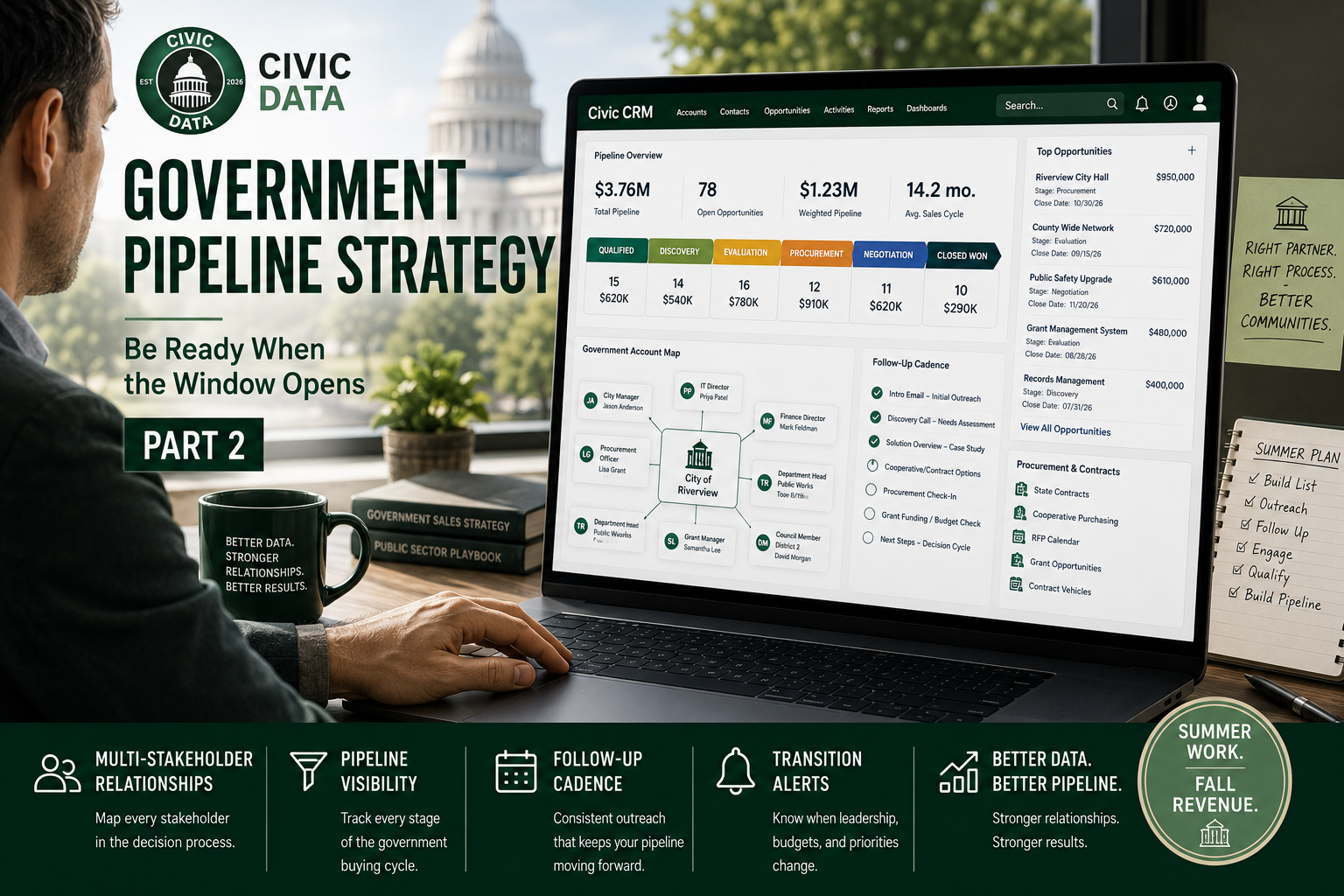
Government deals move slowly until a mandate or ransomware attack makes them move fast. Part 2 covers the pipeline strategy that keeps you ready for both.
Part 1 made the case that July 1 is the most underutilized date in GovTech sales -- when new fiscal year budgets become available, when government inboxes are quiet, and when the outreach most vendors are not sending reaches decision-makers who are actually available. Read that one first.
Part 2 is about the other reality of government sales that every GovTech vendor discovers eventually. Government technology decisions sometimes move at glacial speed. And sometimes they move at emergency speed.
Dallas. Oakland. The ransomware attack that took down a city's court systems, police dispatch, and 311 service overnight. In those markets, a cybersecurity vendor who had a relationship, a cooperative purchasing contract, and a deployment-ready solution closed in weeks rather than the standard 12-to-18-month timeline. The vendors who had not built those relationships before the emergency happened were not called when the emergency happened. They were called after, when the contracts were already signed.
The pipeline management goal in government sales is to be the vendor who gets the call. That requires CRM discipline, cooperative purchasing positioning, and a follow-up cadence that keeps relationships warm through the long standard timeline so you are present and trusted when urgency arrives.
The Government Procurement Reality Every Vendor Needs to Accept
Government procurement is not slow because administrators are indecisive. It is slow because government spending of public money carries accountability requirements that private sector purchasing does not. Competitive bidding thresholds, public records obligations, multi-stakeholder approval chains, legal review, and in many cases elected official authorization are all part of the standard process. A vendor who treats these requirements as obstacles to work around is a vendor that government administrators learn not to trust.
The vendors who win consistently in government understand procurement as a feature rather than a bug. They know which purchasing thresholds trigger competitive bidding and which do not. They know which cooperative purchasing vehicles eliminate the bid requirement for their product category. They know how to structure a proposal that makes the procurement administrator's job easier. That knowledge, communicated naturally in outreach, signals credibility that distinguishes a genuine government market vendor from one running a standard B2B sales playbook in a market it does not understand.
The CRM Setup That Works for Government Sales
Map the Multi-Level Government Account
Government purchasing authority is distributed across multiple levels of an organization in ways most CRM default setups do not capture. The State CIO who sets technology policy is different from the agency program director who controls the operational budget, who is different from the procurement administrator who manages contract execution, who is different from the newly appointed Chief AI Officer with a dedicated AI governance budget. Your CRM needs to map all of these contacts at the same government entity as a connected account -- not as independent contacts with no relationship to each other.
Track Cooperative Purchasing Status
The single most useful field to add to your government account CRM records is cooperative purchasing vehicle participation. Which cooperative purchasing contracts does this entity already buy from? If your product is available on a NASPO ValuePoint, Sourcewell, or OMNIA Partners contract that a specific government entity already participates in, that fact changes your sales motion from a 12-month competitive procurement to one that can close in weeks. Knowing which accounts already have the cooperative purchasing relationship in place is knowing where your fastest sales cycles are hiding.
Log Grant Status and Spending Timelines
Grant-funded government technology purchases operate on timelines driven by grant terms rather than fiscal year calendars. A government entity that received a CISA cybersecurity grant in January has a spending window. A CoC that received HUD Continuum of Care funding in the spring has compliance requirements and spending timelines attached. A school district that received a federal school safety grant six months ago and has not committed the funds is in an active purchasing window right now.
Add a grant status field that tracks which accounts have received relevant grants, when the award was made, and what the spending timeline looks like. This information is publicly available through federal grant databases and state agency announcements. A Civic Data government mailing list integrated with grant award monitoring generates real-time purchasing urgency signals that static contact lists cannot identify. The vendors who act on those signals in the first 30 days of a grant award enter purchasing conversations months before competitors waiting for a standard outreach trigger.
The Follow-Up Cadence for Government Outreach
Government administrators are measured, deliberate, and accountable for vendor relationships in ways that private sector buyers are not. The follow-up approach that works is one that adds something worth reading with every contact rather than adding volume.
- Follow-up one, two weeks out: a relevant policy or regulatory development. The new CISA cybersecurity performance goal. The HUD HMIS data standard update. The state AI governance legislation that was just signed. Something specific to their regulatory environment that shows you are paying attention to their world.
- Follow-up two, four weeks out: a peer reference. A city or county in a similar situation that has deployed your solution. Government administrators trust peer references more than vendor case studies. Name the peer entity. Offer to facilitate an introduction if they want to talk directly.
- Follow-up three, six to eight weeks out: the cooperative purchasing mention if you have it. "I wanted to make sure you are aware that our solution is available on [specific contract vehicle]. If that simplifies the procurement path, I am happy to walk through how other contacts have used it." This is a procurement service, not a sales pitch. It consistently produces responses from contacts who had been non-responsive to earlier outreach.
Summer List-Building for the Government Market
Add the Post-2022 Roles
Any government mailing list or civic email list compiled before 2023 is missing significant purchasing authority. Chief AI Officers appointed under federal and state mandates. State Cybersecurity Coordinators created by the CISA grant program. AI Governance Program Managers implementing state legislative requirements. CoC Coordinators for expanded homelessness services programs. Municipal CFOs with financial analytics mandates from pension and property tax stress. These are primary purchasing contacts for the fastest-growing and most urgent technology categories in state and local government right now. If they are not searchable in your public sector mailing list, you are reaching a market that existed before 2022.
Segment by Urgency Type
The most useful summer segmentation for government outreach groups contacts by the specific urgency type that makes them an active buyer right now. Post-ransomware municipalities for cybersecurity technology. Post-fiscal-year-reset state agencies for AI governance and modernization platforms. New government administrator appointments for relationship-building outreach. Grant-funded entities for the technology category the grant supports. Each urgency type requires a different message and a different call to action -- and a government decision-maker email list that cannot be filtered by urgency type is a list that forces you to write for the average of all of them, which is a message that works for none of them.
Cross-reference across sectors. State education agency officials who administer K-12 safety and CTE grants are government contacts with purchasing influence over every district in their state -- they belong in both civic mailing lists and K12 Data's school mailing lists. State workforce officials who co-fund community college credential programs appear in both government and College Data's college mailing lists. State Medicaid officials whose decisions shape rural healthcare access connect civic mailing lists to Physician Data's physician mailing lists. Vendors whose contact data spans all four sectors reach both the funder and the recipient of the same programs -- a competitive advantage that single-sector government contact lists simply cannot replicate.
The Metric That Tells You Government Outreach Is Working
In government sales, the leading indicator metric is not response rate. It is meeting quality -- specifically whether the meetings you are booking include the right stakeholders and advance to a procurement-adjacent next step. A meeting with a program administrator who is interested but has no budget authority is not a deal. A meeting with a Municipal CFO, a procurement administrator, and a technology director who agree to evaluate your cooperative purchasing proposal is a deal in development.
Track which of your government meetings advance to a procurement conversation versus which stall after a single contact. The pattern in your data will tell you whether your CRM mapping, your meeting structure, or your product positioning is the constraint. Knowing which constraint you are working against is the prerequisite for fixing it.
Government sales move slowly until they do not. The vendors who are positioned -- relationships built, cooperative purchasing in place, CRM current, outreach cadence running -- when urgency arrives are the ones who close in weeks. Building that positioning is a summer project. The urgency that rewards it arrives on its own schedule.
Part 1 covered summer government outreach strategy, email fundamentals, and civic mailing list hygiene. This is Part 2. The same summer strategy series runs for K-12 at K12 Data, for higher education at College Data, and for healthcare at Physician Data.
K12 Data -- Build a List | Pricing | Blog College Data -- Build a List | Pricing | Blog Physician Data -- Build a List | Blog Civic Data -- Build a List | Blog