
Government Vendors: The Budget Year Just Reset. The Inbox Is Quiet. Your Competition Is Napping. Time to Work. (Part 1)

 Federal Agencies
  0
0
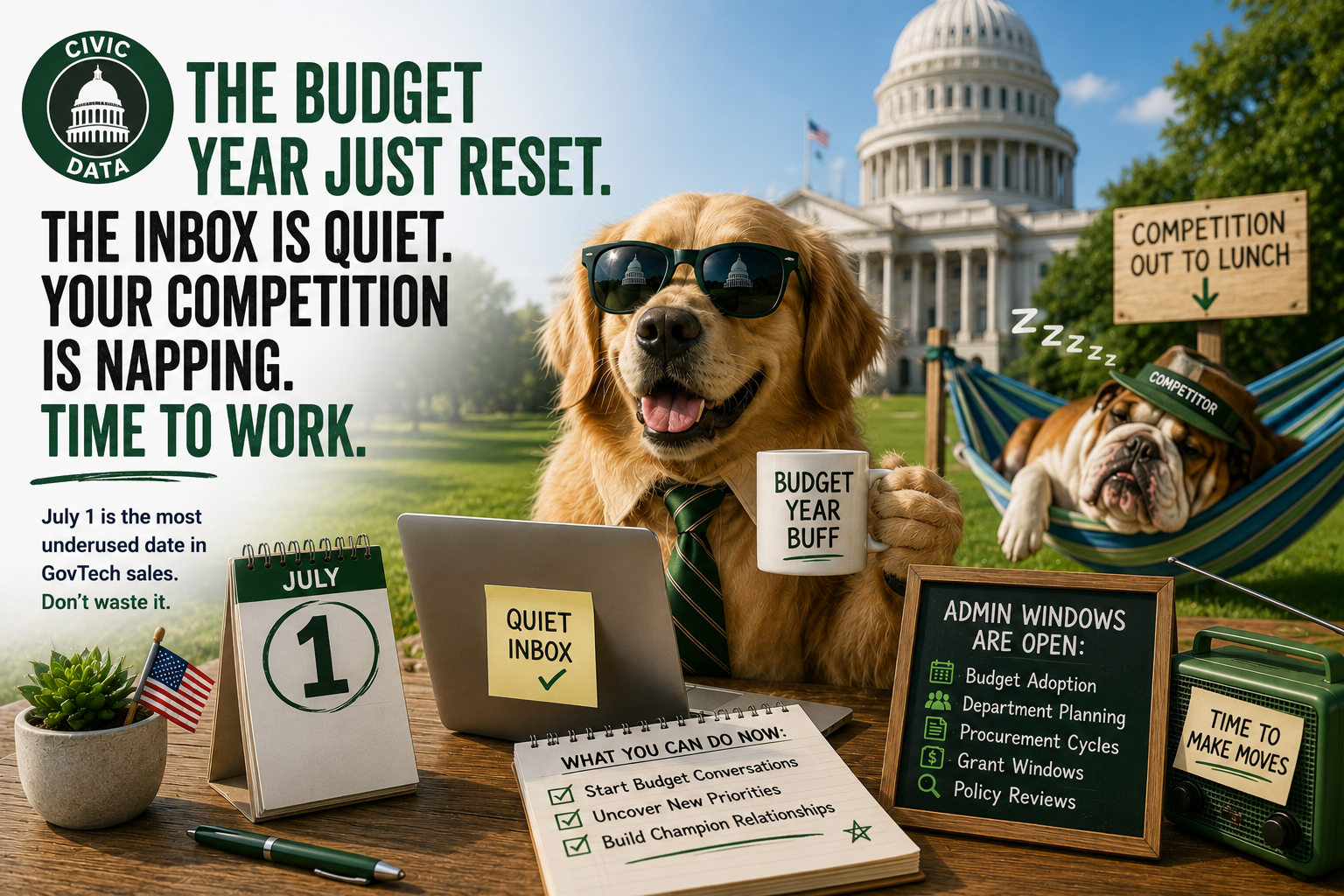
The government fiscal year just reset. Budgets are fresh. Inboxes are quiet. And your competitors are napping. Best time all year to use your civic mailing lists.
July 1 is one of the most important dates in the GovTech sales calendar and almost nobody in the vendor community treats it that way.
On July 1, the new fiscal year begins for the majority of state and local government entities in the United States. Fresh budget dollars are available. The purchase decisions that were "pending the new fiscal year" for the last six weeks are now actionable. The technology evaluations that started in the spring and got paused because the budget was in its final approval phase can now move forward. And the government administrators who were holding back because they could not commit pre-approved funds are now in a position to commit.
At the same moment, the government vendor market is at its quietest. The spring conference season is over. The fall conference calendar has not started. Marketing teams that run on event calendars are in a lull. Inboxes that receive thirty vendor emails per week in October are receiving ten. The decision-makers you have been trying to reach are at their desks, dealing with manageable volumes of communication, with budget authority and time to consider vendor conversations that they could not afford in busier periods.
This is the summer gift to GovTech vendors who recognize it. This is Part 1 of how to use it.
The Government Budget Calendar and Why It Is Your Best Friend
Understanding the government budget calendar is the foundation of effective GovTech outreach. It is also something that a surprising number of vendors operating in the government market do not fully understand, which is a competitive advantage for the ones who do.
Most state governments operate on a fiscal year that runs July 1 through June 30. Most county and municipal governments follow the same cycle, though some run on a calendar year (January 1 through December 31) and a handful have other fiscal year structures. The key date for most of your government contacts is July 1, when new appropriations become available.
The budget approval process typically concludes in late May or June. The period from April through June is when budgets are being finalized, which means technology purchases that require budget approval are being evaluated right now -- even though the money does not officially arrive until July 1. A vendor who is in the conversation in May and June, before the budget is finalized, is in a position to be included in the approved budget. A vendor who shows up in August is competing for discretionary dollars that are already partially allocated.
There is also a grant cycle layer. Federal grant programs -- cybersecurity grants, homelessness services grants, AI modernization grants, workforce development grants -- have their own award timelines and spending deadlines that create purchasing urgency at specific moments throughout the year. A government entity that received a CISA cybersecurity grant in January has a spending window of 18 to 24 months. If they are six months into that window, they are actively evaluating technology right now, regardless of what the general budget calendar says.
Email Marketing Basics for Government Outreach: What Works and What Does Not
Government Administrators Read Fewer Emails Than You Think
The average government IT director or department administrator is not managing the same email volume as a corporate executive in a fast-moving sector. Government operations run at a more measured pace, and the email inbox reflects that. Volumes are lower. Spam filters are often more aggressive because government email systems have institutional IT management. And the administrators who do receive vendor outreach are often more deliberate about what they engage with because purchasing decisions in government carry accountability implications that do not exist in private sector procurement.
What this means for your civic mailing list outreach: quality matters more than volume in government. A well-crafted, well-targeted email to the right government contact is worth more than a high-volume blast to a general government list. The government inbox is not as noisy as a corporate inbox, which means a good message has a better chance of being noticed -- but a sloppy one is also more likely to stand out negatively.
Compliance and Procurement Language Signal Credibility
Government administrators think in procurement terms. They operate within frameworks -- purchasing thresholds, sole source justification requirements, cooperative purchasing eligibility, contract vehicle requirements -- that private sector buyers do not have. An email that demonstrates awareness of these frameworks signals that you understand how government procurement actually works and are not going to waste their time with a sales process that does not fit the procurement environment.
You do not need to lead with procurement language in your subject line. But mentioning that your product is available on a cooperative purchasing contract (NASPO ValuePoint, Sourcewell, OMNIA Partners), that you have GSA schedule pricing, or that your contract is already in place with other government entities in the state is the kind of signal that makes a government administrator significantly more likely to take the next step. It reduces their procurement burden. That is valuable.
The Rule of One Works Even Better in Government
One email. One ask. One link. This is good practice in B2B marketing generally. In government outreach it is essential. Government administrators making purchasing decisions are operating within a stakeholder environment -- they have to justify every vendor conversation to procurement staff, legal, budget officers, and often elected officials. An email that asks them to do five things creates five different internal justification problems. An email that asks for one fifteen-minute call creates one. One is manageable. Five is a reason to move on.
Your Civic Mailing List: The Honest Conversation
Government contact data is among the most frequently purchased and least maintained category of B2B contact data in the market. Here is why this matters and what to do about it.
Government contact turnover is higher than most vendors expect. Elected officials change with every election cycle, bringing new leadership into appointed administrative roles. Staff turnover at government agencies is significant -- the workforce challenges affecting the private sector have hit government too, and the administrative staff who maintained institutional knowledge about vendor relationships for years are not always there anymore. And the creation of new roles -- Chief AI Officers, State Cybersecurity Coordinators, CoC Coordinators for homeless services programs -- means that a government contact database that does not add new role categories as they emerge is missing purchasing authority that was created after the last data refresh.
The turnover problem is compounded by the transition window opportunity. Civic Data's research on new government administrator appointments and purchasing windows documents how the first 60 to 90 days of a new government administrator's tenure is one of the highest-receptivity windows for vendor outreach -- the new administrator is building their vendor roster, is not locked into their predecessor's commitments, and is actively evaluating options before their approach to the role is set. A government mailing list that identifies new appointments through public records monitoring is capturing purchasing urgency that a static contact list cannot see.
On the data quality side: hard bounce rates above 2 percent in government outreach are a warning sign. Government email addresses that bounce are often addresses of people who have left or been reassigned, and in government environments, departed employees's addresses are sometimes kept active and monitored by IT departments -- which means some bounces may actually be delivering to an inbox that is being reviewed and potentially flagging your domain. Clean your list before every major campaign.
Segmenting Your Government Mailing List for Summer
Not all government contacts are at the same point in the budget and decision cycle at the same time. Summer segmentation should account for two key variables: fiscal year timing and whether the contact is at a state agency, a county government, or a municipal government -- because these three tiers have different purchasing processes, different timelines, and different decision-making authority structures.
State Agency Contacts in Summer
State agencies with July 1 fiscal years are in the most active purchasing window of the year right now. State procurement processes are complex and slow -- RFP timelines, vendor evaluation committees, contract approval chains -- which means that a vendor who gets into a state agency conversation in July is typically looking at a 6-to-12-month procurement process that could conclude before the fiscal year ends. Getting in now is getting in early, which is the right place to be.
County and Municipal Contacts in Summer
County and municipal governments often have more flexibility in purchasing below certain dollar thresholds. The cooperative purchasing vehicles that allow them to buy from vendor contracts already awarded at the state or federal level -- NASPO ValuePoint, Sourcewell, OMNIA Partners -- are specifically designed to speed up local government procurement by removing the competitive bidding requirement for eligible purchases. A vendor whose product is available on one of these vehicles and whose civic mailing list outreach leads with that fact is removing the primary procurement friction for county and municipal buyers.
The homelessness services segment of local government is in an especially active purchasing window in summer because federal Continuum of Care grants are typically awarded in the spring and the spending planning for those grants is happening right now. A vendor who serves the homelessness technology market and whose civic mailing list includes CoC Coordinators and Homeless Services Directors should be running a summer campaign specifically timed to the post-award planning window. Physician Data's research documents a parallel post-award purchasing window in FQHC markets, where HRSA grant awards create technology purchasing urgency that vendors who understand the grant calendar can reach at the peak moment.
What to Do This Week
- Send a July 1 fiscal year reset campaign to state and local government contacts on your civic mailing list. Lead with the budget relevance. Something like: "New fiscal year started. If [specific technology] was on your evaluation list for this budget cycle, this week is a good time to pick up that conversation." Keep it short. One ask.
- Review your government mailing list for data quality. Check for hard bounce rates above 2 percent and trace the source. Are they from specific agencies where leadership has changed? That is a data refresh problem.
- Add cooperative purchasing contract information to your standard outreach templates for county and municipal contacts. If you are on NASPO, Sourcewell, or OMNIA -- say so in the email. It removes a procurement friction point immediately.
- Build a list of recent government administrator appointments that are relevant to your product category. State CIO appointments, new county administrators, recently hired Chief AI Officers -- these are your highest-urgency prospects in the next 90 days. Public records and government press releases are your sources.
- Identify the grant-funded government entities in your market -- those who have received cybersecurity grants, homelessness services grants, or workforce development grants in the last 12 months and have spending timelines in progress. These contacts have budget certainty and compliance urgency simultaneously. That is the best possible combination for vendor outreach.
Coming in Part 2
Part 2 of the summer government marketing guide covers the sales strategy and relationship management side: how to navigate the multi-stakeholder government procurement process without losing your mind, the follow-up cadence that keeps GovTech deals moving through long approval chains, how to build and use relationships with cooperative purchasing officials to reach hundreds of government entities through a single strategic relationship, and the CRM practices that make a 12-month government sales cycle manageable rather than mysterious. Part 2 is coming soon.
K12 Data -- Build a List | Pricing | Blog College Data -- Build a List | Pricing | Blog Physician Data -- Build a List | Blog Civic Data -- Build a List | Blog