
The DOJ's April 2026 Accessibility Deadline Just Created a New Wave of Government Decision-Makers

 Federal Agencies
  0
0
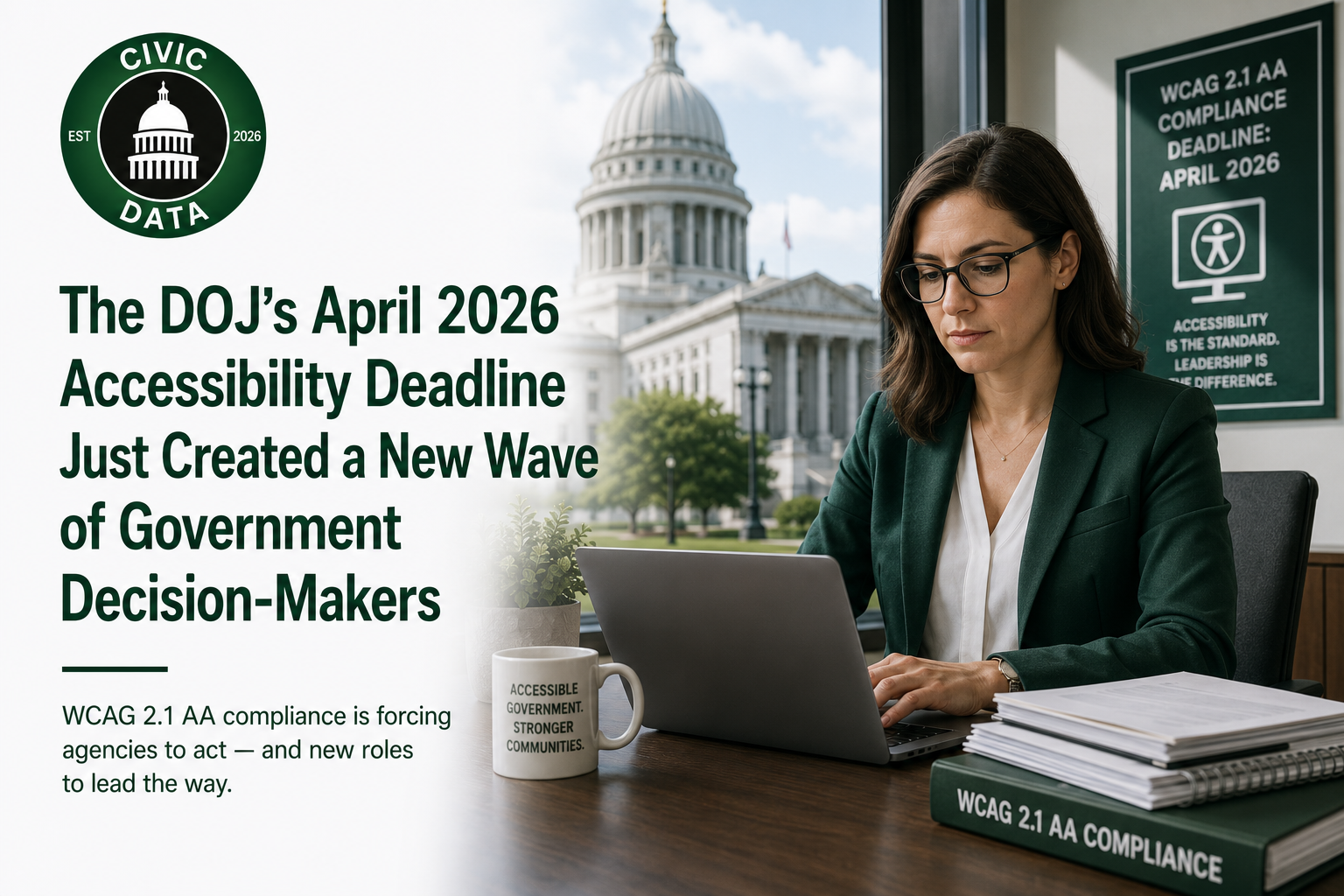
The DOJ's April 2026 web accessibility deadline is forcing state and local governments to designate new compliance leads. Most government mailing lists have not caught up.
The DOJ's April 2026 Accessibility Deadline Just Created a New Wave of Government Decision-Makers
On a fixed date this year, thousands of state and local government websites crossed from optional accessibility best practice into hard legal requirement. The Department of Justice's Title II rulemaking set an April 2026 deadline for most state and local government entities to bring their websites and mobile apps into conformance with WCAG 2.1 AA, with an additional year of runway for jurisdictions under fifty thousand in population. That deadline has now largely passed for the largest jurisdictions, and it is quietly reshaping who inside government actually controls technology budget. Almost nobody selling into government has updated their civic mailing lists to reflect it.
This is exactly the kind of narrow, time-sensitive regulatory shift that creates outsized purchasing urgency and almost no competition, because most vendors are still targeting the same generic city manager and IT director contacts they always have, while a genuinely new layer of accountable decision-makers has emerged specifically because of this mandate. Vendors who identify that new layer first, while everyone else is still pitching yesterday's org chart, get a real head start in a market that rarely offers one. School districts are facing a parallel identification challenge right now, where AI-generated phishing impersonating superintendents is forcing IT and communications staff into new compliance roles almost overnight, much like this accessibility mandate is doing in city and county government.
What the Mandate Actually Requires
Conformance with WCAG 2.1 AA is not a cosmetic checklist. It requires semantic HTML structure, full keyboard navigation, a minimum four-point-five to one color contrast ratio for body text, alt text on every meaningful image, captions on video and audio content, forms that have been tested with actual screen readers, accessible PDFs or HTML equivalents for every downloadable document, and a published accessibility statement with a functioning complaint procedure. Automated scanning tools catch only a fraction of real-world accessibility issues, commonly estimated around thirty percent, which means government agencies serious about compliance are having to invest in manual screen-reader testing, not just a one-time software scan.
For most local governments, none of this existed as a formal, budgeted function two years ago. It does now, and somebody inside every affected jurisdiction has to own it.
The New Decision-Makers This Mandate Is Creating
Jurisdictions responding to this deadline are standing up accessibility coordinator roles, expanding the responsibilities of existing communications directors, and pulling IT directors directly into compliance planning in a way that did not happen before. In many mid-size cities and counties, this function is being assigned to whoever already owns the city website, often a communications director or a webmaster role that previously had nothing to do with legal compliance. In larger jurisdictions, dedicated ADA or accessibility coordinator positions are being created or expanded specifically to manage this requirement, sometimes reporting jointly to the city attorney's office and the IT department because of the legal exposure involved.
This is a government administrator email list that essentially did not exist as a distinct target category eighteen months ago. Government mailing lists built around traditional titles like city manager, IT director, or communications director will catch some of this activity by accident, but they will systematically miss the dedicated accessibility roles that many jurisdictions are creating specifically in response to this deadline, and they will miss the urgency entirely, since a generic IT director pitch does not read as relevant to someone managing an active legal compliance deadline. Higher education institutions faced a similar overnight role-creation problem when the FAFSA disruption forced enrollment offices to build entirely new data monitoring functions that most vendor contact lists took months to catch up to.
Why the Purchasing Window Is Wide Open Right Now
Government technology purchasing tends to move on two speeds: glacially slow until a mandate or deadline forces fast action. This is exactly that kind of forcing function. Jurisdictions facing an April 2026 deadline that has already passed for the largest population tier are now in active remediation mode, working through vendor evaluations for accessibility auditing tools, content management system upgrades, screen-reader-testing services, and accessible document conversion platforms. Jurisdictions under fifty thousand population have an additional year of runway, which means the purchasing window for this second, larger tier of smaller cities and counties is only now beginning to open and will stay active through the coming year.
Government email marketing works best when it is timed to calendar-predictable pressure points, and a hard federal compliance deadline with real legal exposure attached is about as predictable and urgent as this category gets. Healthcare vendors know this pattern well too, since rural hospital closures have created an urgent, mapped technology vacuum that most physician mailing lists still have not caught up to, in much the same way this accessibility deadline has outrun most government contact databases. Vendors who can reach the accessibility coordinators, IT directors, and communications leads managing this specific compliance requirement, at the specific moment their jurisdiction's deadline is approaching or has just passed, are stepping into a conversation the buyer is already having internally, not creating a new one from scratch.
The Compliance Vendors Most Positioned to Win
Accessibility auditing and remediation vendors, content management platforms with built-in compliance tooling, and screen-reader testing services all have a direct, urgent story to tell right now. So do vendors selling accessible document conversion, since the requirement for accessible PDFs or HTML alternatives is one of the more labor-intensive parts of the mandate for jurisdictions with years of legacy documents still posted online. Legal and compliance consulting firms specializing in ADA Title II are also seeing a genuine surge in inbound interest as jurisdictions try to understand their actual exposure and remediation timeline.
What all of these vendors need is a government contact database that has caught up to the organizational reality this mandate created, meaning it correctly identifies accessibility coordinators as their own distinct role, tracks which jurisdictions fall into the earlier or later compliance tier based on population, and reflects the joint IT and communications ownership structure many governments are using to manage this requirement. A civic mailing lists provider still organized entirely around legacy titles like city manager and public works director will connect vendors to people with no direct ownership of this specific purchasing decision.
The Broader Pattern Behind This Mandate
This deadline is also a useful signal of a broader pattern worth watching in government purchasing generally: compliance mandates create fast, concentrated purchasing windows around narrow new roles that most vendor contact databases have not caught up to yet. The same pattern played out with cybersecurity mandates following high-profile ransomware attacks on cities like Dallas and Oakland, and it is playing out again here. Vendors who build the habit of tracking regulatory deadlines and mapping the new decision-maker roles they create, rather than relying on a static, slowly updated government administrator email list, will consistently find purchasing windows that their competitors are still missing entirely.
Government Contact Data Decays Faster Than Almost Any Other Vertical
This mandate is landing on top of a data quality problem that already made government marketing unusually difficult. Local government contact turnover runs remarkably high, with well over forty percent of local government contacts changing in a given year, driven by elections, retirements, reorganizations, and the kind of rapid role creation this accessibility mandate is producing right now. A government email list built even a year ago is likely to be meaningfully wrong today before this mandate is even factored in, and layering a brand-new compliance role on top of that existing churn makes stale data even more dangerous, since the accessibility coordinator role itself did not exist in most jurisdictions' org charts when many providers last refreshed their government administrator email list.
Vendors who treat government contact data as a static asset purchased once and used indefinitely are marketing into ghosts more often than they realize. Campaigns built on outdated government mailing lists are not just underperforming quietly. They are actively reaching former employees, eliminated positions, and job titles that have been reorganized out of existence, which wastes budget and, in a compliance-sensitive category like this one, can actively damage a vendor's credibility with the jurisdictions still evaluating whether to trust an unfamiliar sender.
The Cost of Getting This Wrong
A vendor who reaches out to a jurisdiction about accessibility compliance using outdated titles or a tone that suggests they have not done any homework on the mandate itself risks more than a wasted email. In a category this compliance-sensitive, a poorly targeted or inaccurate pitch can actively damage credibility with a government buyer who is already skeptical of unfamiliar vendors and actively evaluating whether a sender understands the actual regulatory landscape they are operating in. Accuracy here is not a nice-to-have. It is the entire basis for whether the pitch gets taken seriously at all.
Election Years Compound the Timing Problem
Local government leadership turns over meaningfully in even-year elections, and new officials typically spend their first ninety to one hundred twenty days building vendor relationships essentially from scratch. This accessibility mandate is landing in a period where a meaningful share of the officials ultimately accountable for compliance, whether that is a newly elected city council overseeing a communications director's remediation plan or a newly appointed city manager inheriting an in-progress compliance project, may be new to their role entirely. Most government mailing lists do not catch this turnover window before it closes, which means vendors reaching out with generic messaging aimed at whoever held a title a year ago are frequently talking to someone who is no longer in a position to make the decision, or who has just arrived and is actively looking for vendor relationships to help them get oriented quickly.
This is actually good news for vendors with accurate, current data, because a newly arrived official facing an active compliance deadline they did not create is often more receptive to outside help than an entrenched incumbent who feels they already have it handled. Reaching that specific window, accurately, is where verified civic mailing lists earn their value most directly, the same way reaching an employed candidate directly rather than waiting for a job board visit earns its value in education hiring.
How to Actually Segment This Opportunity
Vendors approaching this market effectively are segmenting jurisdictions by population tier first, since that single variable determines which compliance deadline applies and therefore how urgent the conversation is right now versus over the coming year. Within each tier, effective outreach distinguishes between jurisdictions that have a dedicated accessibility coordinator role, which signals a more mature, better-resourced compliance effort likely already evaluating vendors, and jurisdictions where the responsibility has been folded into an existing communications or IT role, which often signals a less-resourced effort still in the early planning stages and potentially more open to a vendor who can offer a fuller service package rather than a narrow point solution.
This level of segmentation requires a government contact database built specifically to track this mandate's organizational impact, not a generic public sector email list treating every city and county as functionally identical. The vendors willing to do this segmentation work are finding a purchasing window with real urgency, a growing population of newly created decision-maker roles, and comparatively little competition from vendors still pitching the same generic city manager and public works director contacts they have always targeted.
The DOJ's WCAG 2.1 AA deadline has already reshaped who owns technology and compliance decisions inside thousands of state and local governments, and the purchasing window it created is active right now for the largest jurisdictions and about to open for everyone else. Vendors reaching the accessibility coordinators, IT directors, and communications leads managing this specific requirement, with government contact data that reflects the roles this mandate actually created, are positioned to win a purchasing cycle most competitors have not even noticed yet.
This Is a Pattern, Not a One-Time Event
It would be a mistake to treat this deadline as an isolated marketing opportunity to chase once and move past. Government compliance mandates of this kind tend to arrive in waves, each one creating a fresh round of new roles, new budget lines, and new purchasing urgency that most static contact lists take months or years to catch up to. Cybersecurity mandates following high-profile ransomware incidents followed exactly this pattern, and a similar dynamic is likely as new state-level AI governance requirements, procurement transparency rules, and data privacy mandates continue to emerge across state and local government. Vendors who build the internal discipline to track these mandates as they land, and to update their government contact database accordingly, will consistently find themselves first in front of decision-makers other vendors have not yet identified.
This kind of tracking is exactly what turns a government contact database from a static list into a genuine competitive advantage.
Ready to reach the government decision-makers managing this compliance deadline? Build a government marketing database, or buy a government email list, with Civic Data today.
K12 Data — Build a List | Pricing | Blog College Data — Build a List | Pricing | Blog Physician Data — Build a List | Blog Civic Data — Build a List | Blog K12 Talent — Post a Job | Search Jobs | Blog